
In the landscape of object-oriented analysis and design, two dominant paradigms govern how software architects structure data and behavior. These approaches define the fundamental rules for creating objects, managing state, and sharing functionality across a system. Understanding the nuances between class-based and prototype-oriented design is critical for building maintainable, scalable, and robust software architectures.
Each paradigm offers a distinct philosophy regarding how entities are defined and how they relate to one another. One relies on static blueprints and strict hierarchies, while the other emphasizes dynamic cloning and delegation chains. This guide explores the mechanics, implications, and trade-offs of both methods to aid in making informed design decisions.
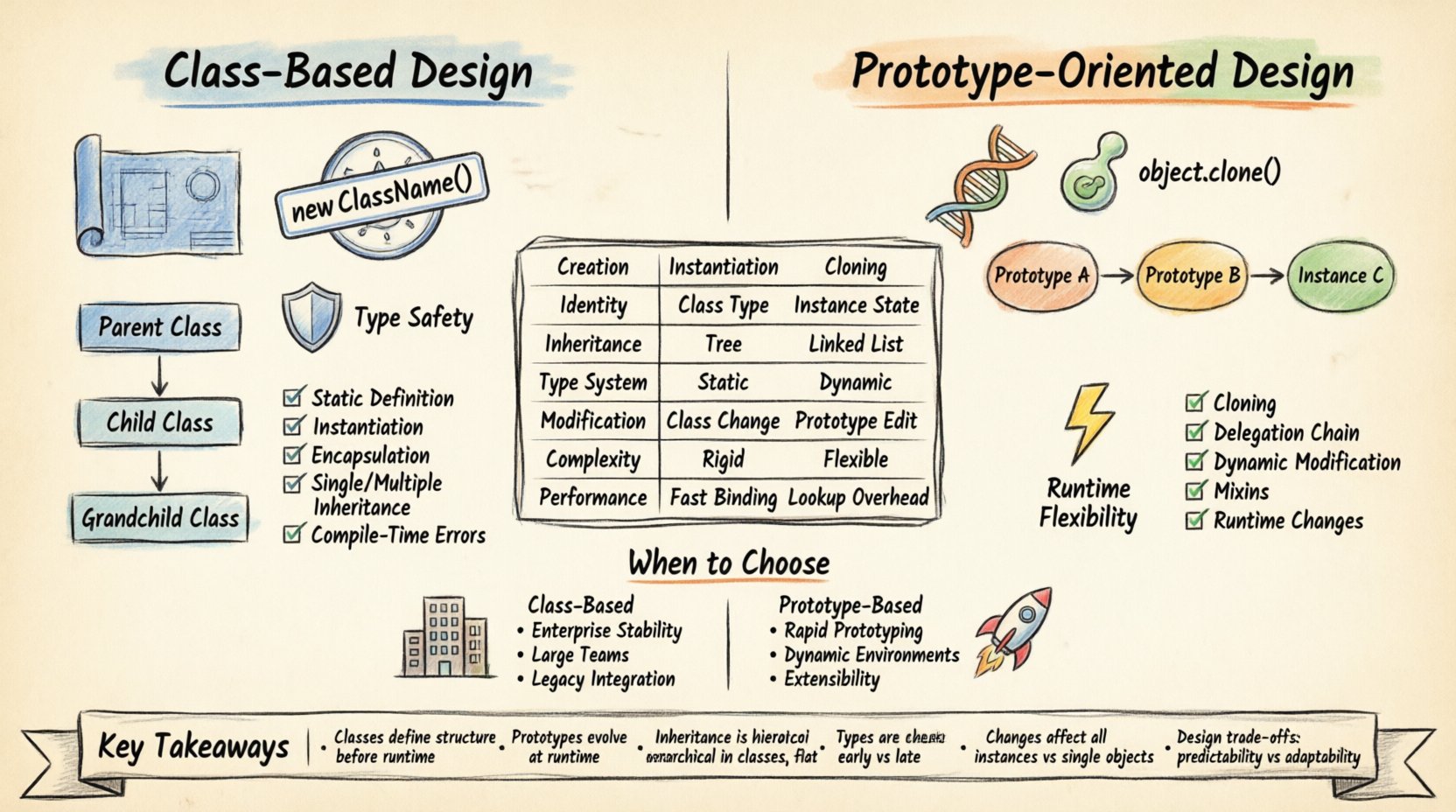
🔨 Class-Based Design Fundamentals
Class-based design operates on the principle of defining a blueprint before instantiation. In this model, a class acts as a static template that specifies the structure and behavior of objects created from it. This approach is deeply rooted in the concept of type systems, where the identity of an object is tied to the class it was instantiated from.
📋 The Blueprint Mechanism
- Static Definition: Before any object exists, the class must be defined. This structure includes attributes (state) and methods (behavior).
- Instantiation: Objects are created by invoking the class constructor. The resulting instances are copies of the class definition at runtime.
- Encapsulation: Data hiding is a core tenet. Internal state is protected from external interference, accessible only through defined interfaces.
🌳 Inheritance Hierarchies
Inheritance in class-based systems is typically vertical. A subclass inherits properties and methods from a superclass, extending or overriding them. This creates a tree-like structure where behavior flows down the chain.
- Single vs. Multiple: Some environments restrict a class to one parent, while others allow multiple inheritance, which can introduce complexity regarding method resolution order.
- Polymorphism: Objects of different subclasses can be treated as instances of the parent class, allowing for flexible function calls without knowing the specific type.
- Code Reuse: Common logic is written once in the superclass, reducing duplication across the codebase.
⚖️ Type Safety and Compilation
Class-based systems often benefit from static type checking. The compiler verifies that objects adhere to their class definitions before execution. This can catch errors early in the development cycle but reduces flexibility at runtime.
- Compile-Time Errors: Mismatches between expected and actual types are flagged during build processes.
- Performance: Static binding can lead to faster execution as the runtime does not need to resolve types dynamically.
- Rigidity: Changing the class structure often requires recompiling dependent modules.
🧬 Prototype-Oriented Design Fundamentals
Prototype-oriented design takes a different path. Instead of starting with a blueprint, it starts with existing objects. New objects are created by cloning or extending existing instances. This model is often associated with dynamic typing and runtime flexibility.
📝 The Prototype Chain
- Cloning: To create a new object, an existing one is duplicated. This new object inherits the properties and methods of the original.
- Delegation: If a property is not found on the object itself, the system looks at its prototype. This chain continues until the property is found or the chain ends.
- Modification: Objects can be modified at runtime. Adding a method to a prototype affects all objects that delegate to it.
🔄 Dynamic Behavior
The dynamic nature of prototype-based systems allows for significant runtime adaptability. You can alter the behavior of an entire group of objects by changing a single prototype.
- Runtime Changes: No recompilation is needed to add new functionality to existing types.
- Mixins: Behavior can be mixed into objects without the constraints of strict class hierarchies.
- Flexibility: Objects are not bound to a single type identity; they can change their structure as the program runs.
🧩 Object-Centric Logic
Logic is often encapsulated within the object itself rather than a separate class definition. This aligns with the philosophy that behavior belongs to the entity, not the abstract definition.
- Direct Modification: You can add properties to a specific instance without affecting others.
- Self-Reference: Objects often reference themselves to maintain state or perform actions.
- Reduced Boilerplate: There is often less code required to define basic structures compared to class-based templates.
📊 Comparative Analysis
The following table outlines the key differences between these two design strategies. It highlights how they handle inheritance, state, and runtime behavior.
| Feature | Class-Based Design | Prototype-Oriented Design |
|---|---|---|
| Creation | Instantiation from a template | Cloning from an existing instance |
| Identity | Tied to the class type | Tied to the instance state |
| Inheritance | Vertical hierarchy (Tree) | Delegation chain (Linked List) |
| Type System | Often Static | Typically Dynamic |
| Modification | Requires class change | Can modify prototype or instance |
| Complexity | High structure, rigid | Low structure, flexible |
| Performance | Faster static binding | Potential lookup overhead |
🛠️ Decision Factors for OOAD
Selecting between these approaches depends heavily on the specific requirements of the system. There is no universal standard; the choice relies on the trade-offs between stability and flexibility.
🏗️ When to Choose Class-Based
- Enterprise Stability: When long-term stability and strict contracts are required.
- Complex Hierarchies: When logical grouping of functionality benefits from deep inheritance trees.
- Team Structure: When large teams need clear boundaries and interfaces to work in parallel.
- Refactoring Needs: When type safety helps prevent regressions during major code changes.
- Legacy Integration: When interfacing with systems that expect static type definitions.
🚀 When to Choose Prototype-Based
- Rapid Prototyping: When features need to change frequently during development.
- Dynamic Environments: When the system must adapt to runtime conditions without restarts.
- Small to Medium Scale: Where the overhead of a complex type system outweighs the benefits.
- Behavior Sharing: When many objects share behavior but differ slightly in state.
- Extensibility: When adding new features to existing objects without breaking existing code is paramount.
🌐 Architectural Implications
The choice of design approach impacts the overall architecture, including memory management, performance, and maintainability.
💾 Memory Management
In class-based systems, memory is often allocated based on the class definition. Instance variables take up space proportional to the class schema. In prototype-based systems, memory is allocated per instance. If many objects are clones, they may share function references but hold unique state data.
- Class-Based: Fixed memory layout per type.
- Prototype-Based: Variable memory layout depending on instance properties.
- Garbage Collection: Dynamic systems may rely more heavily on garbage collection to manage the lifecycle of transient objects.
🔍 Search and Lookup
How a system finds a method to execute differs significantly.
- Class-Based: The runtime knows exactly which method belongs to the class. This allows for direct addressing.
- Prototype-Based: The runtime must traverse the prototype chain to find the method. This adds a lookup cost but enables dynamic behavior.
📉 Maintenance and Evolution
Maintaining a class-based system often involves managing the hierarchy. Breaking changes in a superclass can ripple down to all subclasses. This requires careful versioning and interface management.
In prototype-based systems, changes to a prototype propagate to all dependent objects. While this sounds powerful, it can lead to unintended side effects if multiple independent parts of the system share a common prototype.
- Risk of Leakage: Modifying a shared prototype might affect unintended objects.
- Version Control: Class-based systems allow for easier versioning of types. Prototype systems require careful tracking of object state versions.
🔄 Hybrid Approaches
Modern environments often blend these philosophies to capture the benefits of both. Many systems provide class syntax that compiles to prototype-based behavior, or allow dynamic properties on class instances.
🧩 Metaclasses
Metaclasses allow classes to be treated as objects themselves. This bridges the gap by allowing dynamic modification of class structures while maintaining the static hierarchy benefits.
- Meta-Programming: Allows code to manipulate the class definition at runtime.
- Dynamic Inheritance: Classes can be created or modified dynamically.
🛡️ Type Assertions
Some systems enforce type safety on dynamic objects. This provides the flexibility of prototype design with the safety checks of class-based design.
- Runtime Checks: Validates object structure without strict compilation.
- Documentation: Helps developers understand expected object shapes.
📝 Implementation Considerations
When implementing these designs, specific technical details must be addressed to ensure system health.
🧱 State Management
How state is stored and accessed is crucial. Class-based systems usually define fields explicitly. Prototype systems store properties as key-value pairs within the object.
- Privacy: Class-based systems often have private fields. Prototype systems rely on closure or naming conventions for privacy.
- Accessors: Getter and setter methods are common in both, but their implementation differs in scope and binding.
🔄 Lifecycle Hooks
Managing the life of an object involves initialization and cleanup.
- Constructor: Class-based systems use constructors to initialize state. Prototype systems use initialization methods or configuration steps after cloning.
- Finalization: Cleanup routines must be managed carefully to prevent memory leaks, especially in dynamic environments.
🧪 Testing and Verification
Different testing strategies apply depending on the design approach.
🧪 Class-Based Testing
- Unit Testing: Focuses on specific class behaviors in isolation.
- Interface Testing: Ensures subclasses adhere to parent contracts.
- Mocking: Easier to mock static types for dependency injection.
🧪 Prototype-Based Testing
- Behavioral Testing: Focuses on the object’s response to messages rather than its type.
- State Verification: Verifies the final state of the object after method calls.
- Dynamic Inspection: Tools must inspect object properties at runtime rather than relying on static definitions.
🚧 Common Pitfalls
Awareness of common issues helps in avoiding architectural debt.
🚧 Class-Based Pitfalls
- Deep Inheritance: Creating hierarchies that are too deep makes understanding the code difficult.
- Fragile Base Class: Changing the base class breaks derived classes unexpectedly.
- Over-Engineering: Creating classes for behaviors that might change frequently.
🚧 Prototype-Based Pitfalls
- Namespace Collisions: Property names might conflict if prototypes are shared too broadly.
- Unintended Sharing: Modifying a shared property affects all instances.
- Debugging Complexity: Tracing the prototype chain can be difficult when errors occur.
🔮 Future Directions
The industry continues to evolve, blending these paradigms. Concepts like interfaces and protocols offer type safety without strict class inheritance. Functional programming principles are also influencing how objects are constructed, moving away from mutable state towards immutable data structures.
Architects must remain flexible. As requirements change, the ability to shift between or combine these models ensures the longevity of the software. The goal is not to choose a winner, but to select the tool that fits the problem domain best.
📌 Summary of Key Takeaways
- Class-based design relies on static blueprints and hierarchical inheritance.
- Prototype-based design relies on cloning and delegation chains.
- Type safety and compilation speed favor class-based approaches.
- Runtime flexibility and dynamic modification favor prototype-based approaches.
- Maintenance strategies differ significantly between the two models.
- Hybrid models exist to provide the best of both worlds.
- Testing and debugging require specific strategies for each paradigm.
Selecting the right design approach requires a deep understanding of the system’s lifecycle, team dynamics, and technical constraints. By evaluating these factors objectively, architects can build systems that are both robust and adaptable.