
Strategic planning requires more than just setting targets; it demands a clear understanding of what drives an organization and what stands in its way. The Business Motivation Model (BMM) provides a structured way to represent the reasons behind business decisions. When applied to risk and opportunity analysis, this model becomes a powerful tool for aligning strategy with reality. This guide explores how to leverage BMM elements to identify threats and capitalize on potential gains without relying on specific software tools.
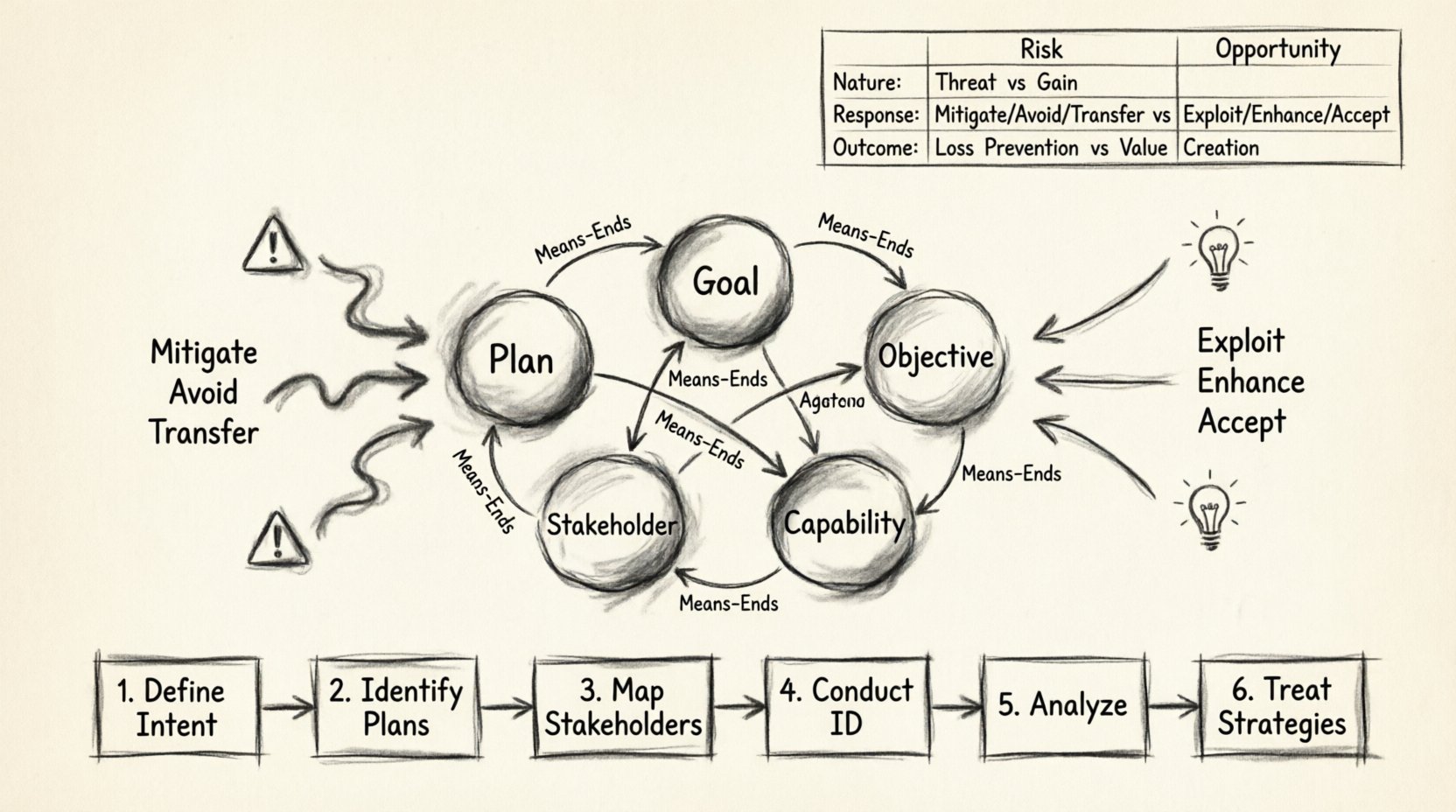
🧩 Understanding the Business Motivation Model Framework
The Business Motivation Model, standardized by the Object Management Group (OMG), is a conceptual model used to capture the intentions, motivations, and influences that drive an enterprise. It does not prescribe a specific process but rather offers a vocabulary to describe business elements and their relationships. For risk and opportunity analysis, understanding these elements is crucial because risks and opportunities are rarely isolated; they affect plans, goals, and objectives.
Core Elements of BMM
At the heart of the model are several key concepts that form the backbone of any strategic analysis:
- Plan: A documented strategy to achieve a goal. It defines the “how” and “when” of execution.
- Goal: A desired future state that is measurable and time-bound.
- Objective: A specific target that supports a goal.
- Stakeholder: Any individual or group that has an interest in the outcome of the enterprise.
- Actor: A role or entity that performs work to achieve objectives.
- Capability: The ability of an enterprise to perform a function or activity.
When analyzing risk, these elements serve as the reference points. A risk is not just a random event; it is a threat to a specific Objective or Goal. Similarly, an opportunity is a potential asset that can help achieve a Goal more efficiently.
🔍 Defining Risk Within the BMM Context
Risk in the context of BMM is defined as an uncertain event or condition that, if it occurs, has a positive or negative effect on the achievement of a Goal or Objective. Traditional risk management often focuses on threats, but BMM broadens this to include the impact on strategic intent.
Identifying Risk Sources
To conduct a thorough analysis, you must map risks to specific BMM elements. This ensures that mitigation strategies are aligned with business intent rather than just technical constraints.
- Risk to Plans: Delays in execution, budget overruns, or resource shortages that prevent a Plan from delivering results.
- Risk to Goals: External market shifts or internal capability gaps that make a Goal unachievable.
- Risk to Stakeholders: Loss of trust, regulatory fines, or reputation damage affecting the people invested in the enterprise.
- Risk to Capabilities: Obsolescence of technology or loss of skilled personnel.
Means-Ends Relationships
The BMM uses “Means-Ends” relationships to connect elements. A Plan is a Means to achieve an End (Goal). When analyzing risk, you must consider the fragility of this link. If a Plan relies on a specific Capability, and that Capability is high-risk, the entire Goal is threatened. This hierarchical view allows for targeted risk assessment.
For example, if a Goal is “Increase Market Share,” and the Plan involves “Launching a New Product,” the risk of product failure directly impacts the Goal. By mapping this relationship, you can prioritize resources to the most critical Plans.
💡 Defining Opportunity Within the BMM Context
Opportunities are the flip side of risk. They represent conditions that, if seized, can positively influence the achievement of Goals or Objectives. In many frameworks, opportunities are overlooked in favor of risk mitigation. The BMM corrects this by treating motivation as a driver for both protection and growth.
Types of Opportunities
Opportunities can be categorized based on which BMM element they influence:
- Capability Opportunities: New technologies or processes that allow Actors to work faster or more accurately.
- Market Opportunities: Changes in customer behavior that create demand for new Services.
- Strategic Opportunities: Partnerships or acquisitions that accelerate a Goal.
- Efficiency Opportunities: Cost reductions that free up resources for other Plans.
Linking Opportunities to Motivation
Every Opportunity should be traced back to a Stakeholder Motivation. Why does the organization want to pursue this? Is it for revenue growth (Objective) or market dominance (Goal)? By anchoring opportunities to motivations, you ensure that resources are not wasted on initiatives that look good but do not support the core strategy.
Consider a scenario where a new software tool is proposed. Instead of asking “Does it work?”, ask “Which Objective does this support?” If the tool improves efficiency for a specific Plan, it is a valid opportunity. If it supports a Goal that has been deprioritized, it is a distraction.
🤝 The Role of Stakeholders and Actors
Stakeholders and Actors are the human elements of the model. They define the appetite for risk and the definition of value for opportunities. Without understanding their perspectives, a risk analysis remains theoretical.
Stakeholder Influence on Risk
Different stakeholders have different tolerances for risk. A Board of Directors might prioritize stability, while a Product Team might prioritize speed. The BMM allows you to map these influences.
- Regulatory Bodies: May view compliance as a non-negotiable Goal. Non-compliance is a critical risk.
- Customers: May view data privacy as a Goal. A breach is a direct threat to their trust.
- Investors: May view ROI as a primary Objective. Cost overruns are a significant risk.
Actors and Capability Gaps
Actors are the ones doing the work. If an Actor lacks the Capability to execute a Plan, a risk exists. Identifying these gaps early allows the organization to invest in training or hiring before a failure occurs. Conversely, if an Actor has excess Capability, there is an opportunity to expand the scope of a Plan.
📊 Comparing Risk and Opportunity Mechanisms
To visualize the relationship between risk and opportunity within the BMM, consider the following comparison table. This structure helps analysts distinguish between threats and enablers.
| Feature | Risk (Threat) | Opportunity (Gain) |
|---|---|---|
| Focus | Preventing negative outcomes | Creating positive outcomes |
| BMM Element | Threatens Plan or Goal | Supports Plan or Goal |
| Stakeholder View | Loss of value or trust | Gain of value or efficiency |
| Management Action | Mitigate, Avoid, Transfer | Exploit, Enhance, Accept |
| Time Horizon | Often immediate or short-term | Often medium to long-term |
Using this table during workshops helps stakeholders see that risk and opportunity are two sides of the same coin. A Plan that has high risk might also have high opportunity potential. The decision lies in the calculated trade-off.
🛠️ Step-by-Step Application Guide
Implementing this analysis requires a disciplined approach. There is no single software wizard that does this automatically; it requires human insight structured by the model.
Step 1: Define Strategic Intent
Start by documenting the Goals and Objectives. Ensure they are SMART (Specific, Measurable, Achievable, Relevant, Time-bound). If the Intent is vague, the analysis will be flawed. Use the BMM to document the “Why” behind these goals.
Step 2: Identify Plans and Capabilities
List the Plans required to achieve the Goals. Identify the Capabilities needed to execute these Plans. This creates the baseline architecture. You cannot assess risk without knowing what you are trying to build or do.
Step 3: Map Stakeholders and Motivations
Identify who cares about these Goals. Document their motivations. Some may be financial, others may be social or operational. This step ensures that risk criteria are aligned with what stakeholders actually value.
Step 4: Conduct Risk and Opportunity Identification
Brainstorm events that could affect the Plans and Capabilities. Categorize them as Risks or Opportunities. Use the Means-Ends links to trace the impact. Does this event stop the Plan? Does it help the Plan?
Step 5: Analyze and Prioritize
Assign a likelihood and impact score to each item. However, do not rely solely on numbers. Consider the strategic importance of the Goal being affected. A low-likelihood risk to a critical Goal might be higher priority than a high-likelihood risk to a minor Objective.
Step 6: Develop Treatment Strategies
For Risks: Decide whether to avoid, mitigate, transfer, or accept. Update the Plan to reflect these changes. For Opportunities: Decide whether to exploit, enhance, or share. Adjust the Capabilities or Actors to seize the opportunity.
⚠️ Common Implementation Challenges
While the model is robust, applying it in practice can present difficulties. Awareness of these pitfalls helps maintain the integrity of the analysis.
- Over-Complication: Trying to map every single risk to every single Goal creates noise. Focus on the critical paths that drive the main Enterprise Goals.
- Static Analysis: The business environment changes. A BMM analysis is a snapshot. It must be reviewed regularly to remain relevant.
- Disconnect from Execution: If the risk analysis stays in a document and does not update the actual Plans, it is useless. The Plans must be the living repository of the risk strategy.
- Ignoring Soft Factors: Culture and morale are risks and opportunities that are hard to quantify but vital. Actors’ motivation is a key BMM element that often gets overlooked.
📈 Measuring Success and Alignment
How do you know the analysis was effective? Success is measured by the alignment between the intended Goal and the actual outcome, and the ability to navigate disruptions.
Key Performance Indicators
Track metrics that reflect the health of the BMM relationships:
- Goal Achievement Rate: Percentage of Goals met on time.
- Risk Incidence: Number of identified risks that materialized.
- Opportunity Realization: Number of opportunities successfully capitalized on.
- Plan Adherence: How often Plans deviate from the original schedule or budget.
Feedback Loops
Integrate the findings back into the BMM. If a Plan consistently fails due to a specific risk, update the Plan or the Goal. If an Opportunity was missed, update the Capability assessment. This creates a continuous improvement cycle where the model evolves with the enterprise.
🔗 Integration with Other Frameworks
The Business Motivation Model does not exist in isolation. It complements other enterprise frameworks.
- TOGAF: BMM provides the “Why” for the Architecture Vision in TOGAF.
- BPMN: BMM Goals drive the objectives of Business Processes modeled in BPMN.
- ITIL: Risk management in ITIL aligns with the Risk elements in BMM.
By using BMM as the bridge, you ensure that technical risks are understood in the context of business value. This prevents the common issue where IT teams mitigate risks that do not matter to the business, or business teams pursue goals that IT cannot support.
🏁 Final Thoughts on Strategic Clarity
Using the Business Motivation Model for risk and opportunity analysis transforms strategy from a document into a dynamic system. It forces clarity on what matters, who cares, and what could go wrong or go right. By focusing on the relationships between Plans, Goals, and Stakeholders, organizations can make decisions that are grounded in reality rather than hope.
This approach requires discipline and consistent review. It is not a one-time exercise but a mindset. When every Plan is linked to a Goal and every Goal is linked to a Stakeholder Motivation, risk and opportunity become manageable components of the business landscape rather than unpredictable surprises.
Start with your core Goals. Map your Plans. Identify your Actors. Then, look for the threats and the gains. This structured path leads to resilient strategies that can withstand market volatility and seize the advantages that appear along the way.