
In the modern enterprise landscape, regulatory compliance is not merely a checkbox activity; it is a strategic imperative. Organizations face a complex web of local, national, and international regulations that dictate how data is handled, how products are manufactured, and how services are delivered. Navigating this landscape requires a structured approach that aligns business objectives with external mandates. This is where the Business Motivation Model (BMM) proves its value.
The BMM offers a standardized framework for understanding the forces that drive an organization. By applying this model to compliance planning, leaders can move from reactive firefighting to proactive governance. This guide explores how to leverage the Business Motivation Model to build a robust regulatory compliance strategy, ensuring that your organization remains agile, lawful, and resilient.
🎯 Understanding the Business Motivation Model
Before integrating compliance into your strategy, it is essential to understand the core components of the Business Motivation Model. Developed by the Object Management Group (OMG), BMM provides a vocabulary and structure for describing the motivation behind business actions. It focuses on the relationships between goals, stakeholders, and the environment.
The Core Constructs
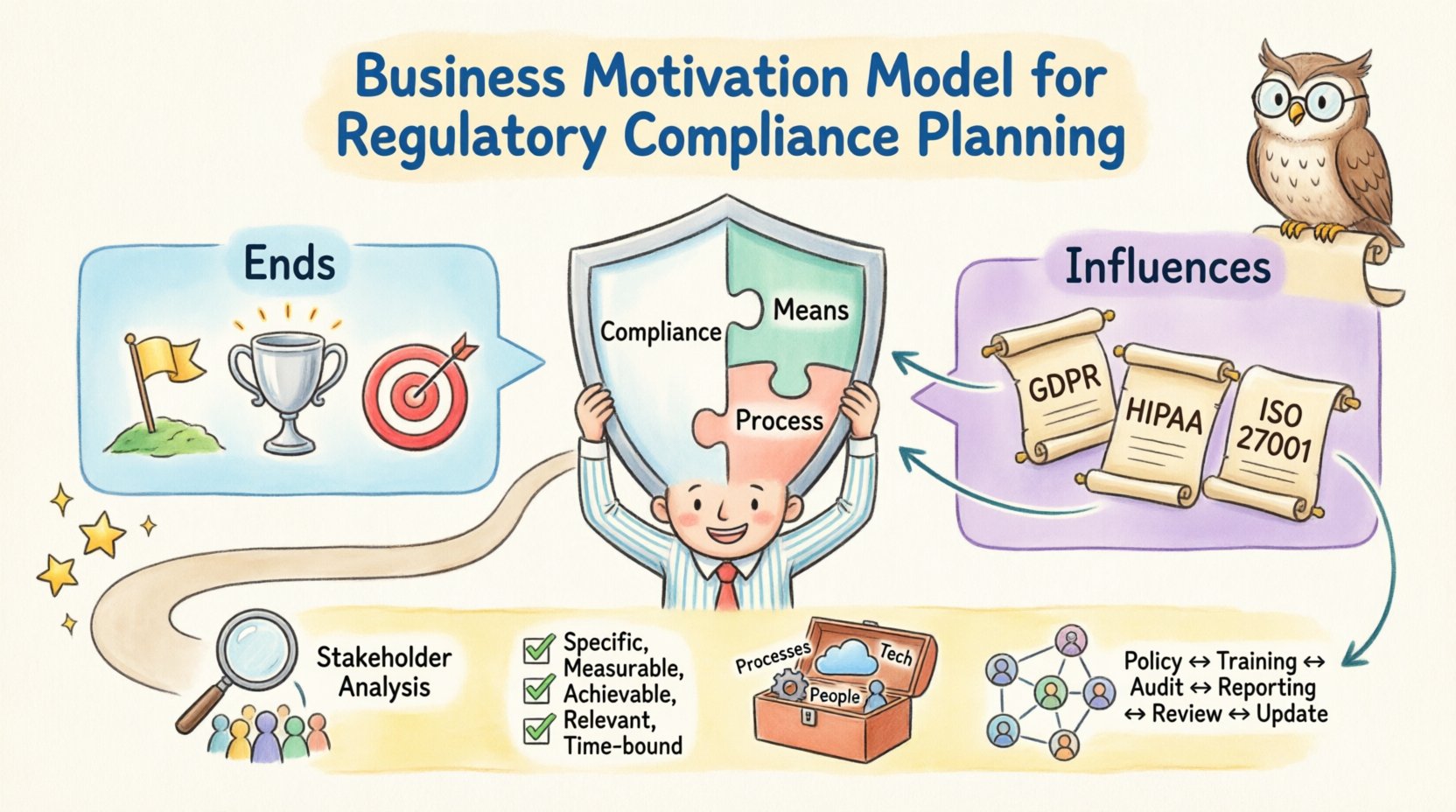
The model divides business motivation into two primary categories: Ends and Means.
- Ends: These are the desired outcomes or goals. In a compliance context, an End might be “Maintain Legal Standing” or “Protect Customer Data Integrity.” Ends are what the organization strives to achieve.
- Means: These are the activities, resources, or strategies used to achieve the Ends. For compliance, a Mean could be “Conduct Annual Security Audits” or “Implement Access Control Policies.” Means are the actions taken to realize the goals.
Furthermore, the model accounts for Stakeholders and Influences.
- Stakeholders: Any party with an interest in the business. In compliance, these include regulators, customers, employees, and investors.
- Influences: Factors that affect the ability to achieve goals. Regulations are a prime example of an Influence. They can be positive (incentives for compliance) or negative (penalties for non-compliance).
⚖️ Integrating Regulatory Compliance into BMM
Applying the Business Motivation Model to compliance requires mapping regulatory requirements to the existing business structure. This process transforms abstract legal text into actionable business logic.
Classifying Regulations as Influences
Regulations are typically external forces that dictate constraints on business operations. In the BMM framework, these are best categorized as Influences.
- Direct Influences: Laws that immediately impact operations (e.g., GDPR, HIPAA, SOX).
- Indirect Influences: Standards or guidelines that shape industry norms (e.g., ISO 27001, NIST).
By labeling these as Influences, the model clarifies their role. They are not internal goals but external pressures that the organization must respond to in order to succeed.
Translating Compliance into Goals (Ends)
While regulations are influences, the desire to comply often becomes an internal goal. You must convert the influence into a measurable End.
- Regulation: “Data must be encrypted at rest.”
- Compliance Goal: “Achieve 100% Encryption of Sensitive Databases.”
This translation is critical. It shifts the focus from “following a rule” to “achieving a state of security.” This mindset shift encourages innovation in how compliance is achieved rather than just adhering to the letter of the law.
📋 Step-by-Step Compliance Planning with BMM
Implementing a compliance strategy using the BMM involves a systematic process. The following steps outline how to structure your planning efforts to ensure nothing is overlooked.
1. Identify Stakeholders and Influences
Begin by listing all relevant parties and regulatory bodies. Create a comprehensive inventory.
- Regulatory Bodies: Who enforces the rules? (e.g., SEC, FDA, Data Protection Authorities).
- Internal Stakeholders: Who is affected? (e.g., IT Security, Legal, HR, Operations).
- External Stakeholders: Who expects compliance? (e.g., Clients, Partners, Shareholders).
Document the specific Influence each party represents. For instance, a Client Influence might be “Contractual Data Privacy Requirements,” while a Regulatory Influence is “Statutory Reporting Obligations.”
2. Define Strategic Compliance Goals
With influences identified, define the Ends. These goals should be SMART (Specific, Measurable, Achievable, Relevant, Time-bound).
- Specific: Define exactly which regulation is being addressed.
- Measurable: Define the metric for success (e.g., “Zero violations per quarter”).
- Achievable: Ensure the organization has the resources to meet the goal.
- Relevant: Align the goal with broader business objectives.
- Time-bound: Set deadlines for implementation and maintenance.
3. Develop Means to Achieve Goals
Once goals are set, determine the Means. These are the activities and resources required.
- Processes: Define the workflows (e.g., Incident Response Procedures, Data Retention Policies).
- Technology: Identify the tools and systems needed (e.g., Encryption tools, Logging systems).
- Personnel: Assign roles and responsibilities (e.g., Compliance Officer, Data Stewards).
4. Establish Relationships and Dependencies
The power of BMM lies in understanding connections. Map how specific Means support specific Ends and how Influences impact them.
- Support: Does a specific audit process support the goal of “Data Integrity”?
- Dependency: Is the implementation of encryption dependent on the budget approval?
- Constraint: Does a specific regulation constrain a new product launch?
This mapping creates a traceability matrix that is invaluable during audits and internal reviews.
📊 Mapping BMM Elements to Compliance Artifacts
To visualize how the model translates into practical documentation, consider the following mapping table. This structure helps teams understand what BMM element corresponds to a compliance artifact.
| BMM Element | Compliance Equivalent | Example |
|---|---|---|
| Influence | Regulation / Standard | General Data Protection Regulation (GDPR) |
| Goal (End) | Compliance Objective | Achieve full GDPR Article 32 compliance for cloud storage |
| Means (Activity) | Control / Process | Implement multi-factor authentication for all cloud access |
| Stakeholder | Owner / Assignee | Chief Information Security Officer (CISO) |
| Assessment | Audit / Review | Quarterly Security Assessment Report |
🔄 Managing Dynamic Regulatory Changes
Regulations are not static. They evolve over time. A static compliance plan quickly becomes obsolete. The Business Motivation Model supports dynamic management through its emphasis on feedback loops.
Monitoring Influences
You must continuously monitor the regulatory environment. New laws are passed, and existing ones are amended. When an Influence changes, the entire model needs review.
- Change Management: Establish a process to review new regulations within 30 days of publication.
- Impact Analysis: Determine if the new Influence requires a change to existing Goals or Means.
- Communication: Inform stakeholders immediately of changes that affect their responsibilities.
Feedback Loops
Use assessment results to refine the model. If an audit reveals a gap in a specific Control (Means), the data should feed back into the Goal definition.
- Gap Analysis: Compare current performance against the defined Goal.
- Root Cause: If a Goal is missed, analyze if it was a failure of the Means or an unrealistic Goal.
- Adjustment: Update the BMM structure to reflect the new reality.
⚠️ Common Challenges in Compliance Planning
While the Business Motivation Model provides clarity, implementing it in a compliance context presents specific challenges. Being aware of these allows for better mitigation strategies.
1. Over-Centralization
Compliance efforts often become the sole responsibility of the Legal or Compliance department. This creates a bottleneck.
- Solution: Use the BMM to distribute Means across the enterprise. Ensure IT, HR, and Operations have defined Means that contribute to the Compliance Goal.
2. Vague Goals
Goals like “Be Compliant” are too broad to measure.
- Solution: Break down high-level goals into specific, measurable sub-goals. Instead of “Be Compliant,” use “Achieve 100% completion of mandatory annual training for all staff.”
3. Ignoring Negative Influences
Focusing only on what you can do, while ignoring what you must avoid.
- Solution: Explicitly map penalties and risks as Negative Influences. Ensure the cost of non-compliance is factored into the business case for compliance activities.
4. Lack of Traceability
When an audit occurs, proving how a specific control links to a regulation is difficult without documentation.
- Solution: Maintain the BMM documentation rigorously. Every Means should link to a Goal, and every Goal should link to an Influence (Regulation).
📈 Measuring Success and Outcomes
How do you know if your BMM-based compliance plan is working? You need Key Performance Indicators (KPIs) that reflect the health of the model.
- Goal Achievement Rate: Percentage of defined Compliance Goals met within the reporting period.
- Mean Efficiency: Cost and time required to execute the Means (Controls/Processes).
- Influence Coverage: Percentage of known regulatory Influences that have a mapped Goal and Means.
- Audit Findings: Number and severity of non-conformities identified during external or internal audits.
Regularly review these metrics. If the Influence Coverage is low, you are exposed to risk. If the Mean Efficiency is low, your compliance activities may be too costly or cumbersome, threatening the business.
🛠️ Building a Sustainable Compliance Culture
The ultimate aim is not just a compliant organization, but a resilient one. The Business Motivation Model helps build this culture by making compliance visible and understandable to everyone.
Communication is Key
Use the BMM structure to communicate why compliance matters. Instead of saying “The law says so,” explain the relationship between the Regulation (Influence), the Business Goal (End), and the Employee Action (Means).
- Visualizations: Use diagrams to show how employee actions impact business goals.
- Training: Train staff on how their role fits into the broader compliance strategy.
- Feedback: Encourage employees to report when a Means (process) is hindering their ability to meet a Goal (efficiency).
Continuous Improvement
Compliance is a journey, not a destination. The BMM supports continuous improvement by allowing for iterative updates.
- Regular Reviews: Schedule quarterly reviews of the BMM structure.
- Lessons Learned: Incorporate findings from incidents or near-misses into the model.
- Adaptation: Be willing to change Goals and Means as the business environment shifts.
🚀 Strategic Advantages of the BMM Approach
Adopting the Business Motivation Model for compliance planning offers distinct advantages over ad-hoc approaches.
- Clarity: It removes ambiguity about who is responsible for what.
- Alignment: It ensures compliance activities support business strategy rather than hinder it.
- Agility: It allows for rapid adaptation to new regulations by updating specific nodes in the model.
- Transparency: It provides a clear audit trail for regulators and stakeholders.
- Efficiency: It helps eliminate redundant controls by showing overlaps in the Means.
🔍 Conclusion
Regulatory compliance is a complex challenge that requires a structured, strategic approach. By utilizing the Business Motivation Model, organizations can transform compliance from a burden into a strategic asset. The framework provides the necessary tools to map influences to goals and goals to actions, creating a clear path forward.
When you align your business motivation with regulatory requirements, you build a foundation for sustainable growth. This approach ensures that your organization remains lawful, secure, and capable of adapting to the ever-changing regulatory landscape. The effort invested in structuring your compliance strategy using BMM pays dividends in reduced risk, improved efficiency, and enhanced stakeholder trust.
Start by mapping your current influences and goals. Identify the gaps between your current Means and your required Ends. With the Business Motivation Model as your guide, you can navigate the complexities of compliance with confidence and precision.