
In the complex landscape of modern enterprise, strategy often remains a document rather than a living directive. Organizations frequently struggle to connect high-level ambitions with daily execution. The Business Motivation Model (BMM) offers a structured approach to bridge this gap. By defining what an organization wants to achieve and how it intends to get there, companies can foster genuine alignment across departments and stakeholders. This guide explores the fundamental principles of the BMM and provides actionable guidelines for integrating these concepts into your organizational framework.
Organizational alignment is not merely about communication; it is about structural coherence. When every team understands their role in the broader mission, friction decreases, and efficiency increases. This document serves as a foundational resource for architects, managers, and strategists looking to implement motivation-driven planning without relying on proprietary tools.
Understanding the Business Motivation Model (BMM) 🧩
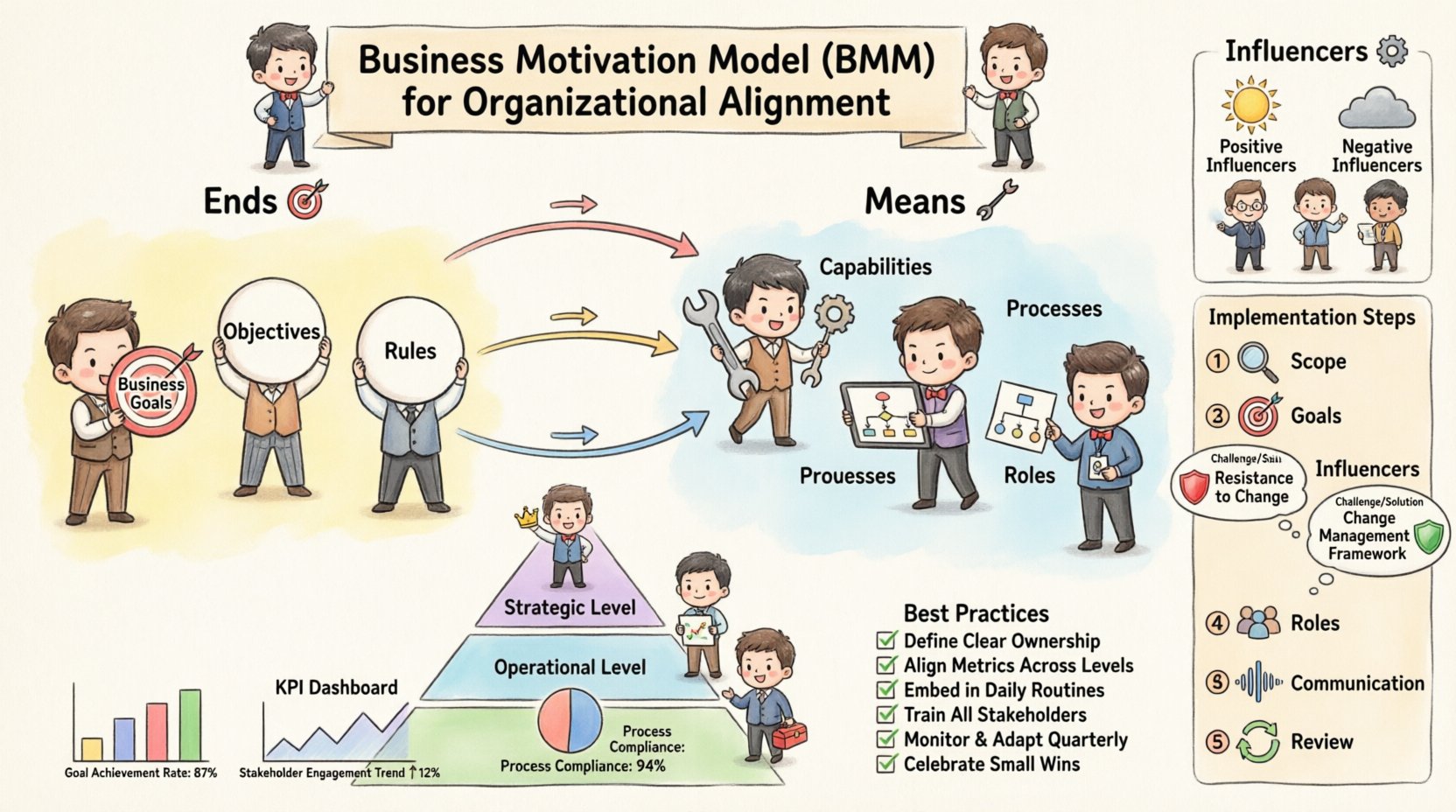
The Business Motivation Model is a methodology designed to support enterprise architecture and strategic planning. It provides a standardized way to describe the motivations of an organization. Unlike simple goal-setting lists, BMM focuses on the relationships between various elements of motivation. It allows businesses to visualize how a specific tactic contributes to a broader strategic goal.
At its core, the model addresses two primary questions:
- What does the organization want to achieve? (Ends)
- How will the organization achieve it? (Means)
These questions are expanded by analyzing the factors that influence the success of these goals. By mapping these elements, an organization gains clarity on the drivers behind its decisions. This clarity is essential for maintaining alignment during periods of change or growth.
Implementing this model requires a shift in perspective. It moves the focus from static planning to dynamic motivation. It recognizes that motivations change over time and that the means to achieve them must adapt accordingly. This flexibility ensures that the organization remains responsive to market conditions while staying true to its core mission.
Core Elements of the Business Motivation Model 🏗️
To utilize the BMM effectively, one must understand its constituent parts. These elements form the vocabulary of organizational alignment. Each part plays a specific role in the ecosystem of business strategy.
1. Ends 🎯
Ends represent the desired outcomes or goals of the organization. They are the destinations the enterprise aims to reach. Ends can be categorized into several types:
- Business Goals: High-level objectives that drive the entire organization. Examples include market expansion or cost reduction.
- Business Objectives: Specific, measurable targets derived from goals. These are often time-bound.
- Business Rules: Constraints that must be followed during the pursuit of ends. These ensure compliance and ethical standards.
Defining Ends clearly prevents ambiguity. When a goal is vague, teams interpret it differently, leading to misalignment. Specificity in Ends ensures that every department pulls in the same direction.
2. Means 🛠️
Means are the methods, capabilities, or resources used to achieve the Ends. Without means, Ends remain abstract concepts. The model distinguishes between different types of means:
- Business Capabilities: The skills, technologies, or processes required to execute strategy. For example, a customer service capability or a data analytics capability.
- Business Processes: The workflows that transform inputs into outputs. These are the daily activities that support the organization.
- Business Roles: The specific functions or positions responsible for carrying out tasks. This clarifies accountability.
- Positive Influencers: Factors that help achieve goals, such as a favorable economic climate or a skilled workforce.
- Negative Influencers: Factors that hinder progress, such as regulatory changes or supply chain disruptions.
- Stakeholders: Individuals or groups with an interest in the outcome. Their motivation must be considered to ensure support.
- Executive Leadership: They define the strategic direction and allocate resources.
- Employees: They execute the plans and require clarity on their roles.
- Customers: They provide revenue and feedback, influencing product direction.
- Regulators: They set rules and compliance requirements that act as constraints.
- Investors: They expect returns and monitor financial performance.
- Solution: Create cross-functional teams. Align departmental KPIs with the overall business Ends. Encourage shared accountability for major initiatives.
- Solution: Use the SMART criteria (Specific, Measurable, Achievable, Relevant, Time-bound). Ensure every goal has a clear definition of success.
- Solution: Involve employees in the planning process. Explain the “Why” behind the changes. Provide training and support to build confidence.
- Solution: Prioritize goals. Focus on high-impact Ends first. Be willing to adjust the timeline or scope based on resource availability.
- Do you understand how your work contributes to the company goals?
- Do you feel your department’s priorities match the overall strategy?
- Are resources allocated effectively to support your goals?
- Start with the Ends: Define what success looks like before planning the how.
- Connect the Dots: Ensure every task links back to a strategic goal.
- Engage Stakeholders: Understand the motivations of those who drive the work.
- Monitor Influencers: Stay aware of external factors that could disrupt plans.
- Review Regularly: Treat the model as a dynamic tool, not a static document.
Aligning Means with Ends is critical. If an organization sets a goal of digital transformation but lacks the technical capability, the goal is unachievable. The BMM forces leaders to assess if their Means are sufficient for their Ends.
3. Influencers ⚙️
Influencers are the external or internal factors that impact the Ends and Means. They are not actions taken by the organization but conditions that affect the outcome. Understanding Influencers allows for better risk management.
By mapping Influencers, an organization can anticipate challenges. This proactive stance is superior to reactive problem-solving. It allows the business to adjust its Means before an Influencer becomes a critical failure point.
Strategic Alignment Framework 🤝
Alignment is the process of ensuring that all parts of the organization work together to achieve the same Ends. The BMM provides a framework for this alignment. It connects the strategic layer to the operational layer. Without this connection, strategy remains disconnected from execution.
Effective alignment requires a clear hierarchy of motivation. High-level goals must cascade down to specific tasks. This hierarchy ensures that every employee understands how their daily work contributes to the bigger picture.
| Level | Focus | Example |
|---|---|---|
| Strategic | Long-term vision and major goals | Increase market share by 10% |
| Tactical | Resource allocation and department goals | Launch new marketing campaign |
| Operational | Day-to-day tasks and activities | Process customer inquiries daily |
When alignment is strong, resources are not wasted on activities that do not support the core Ends. When alignment is weak, organizations suffer from siloed efforts and conflicting priorities. The BMM helps identify these conflicts early.
Stakeholder Engagement and Mapping 🗺️
Stakeholders are the people who drive or are affected by the organization’s motivation. Their alignment is just as important as the alignment of processes and goals. Different stakeholders have different motivations, which must be understood and managed.
Identifying Key Stakeholders
The first step in stakeholder management is identification. This involves listing all parties who have a vested interest in the business outcome. Common stakeholders include:
Mapping Motivations
Once identified, each stakeholder group must be mapped against the organizational Ends. This mapping reveals potential conflicts or synergies. For example, investors may prioritize short-term profits, while the strategic goal might focus on long-term R&D.
Resolving these conflicts is a key part of the BMM process. It involves negotiation and trade-offs. The goal is to find a balance where all key stakeholders feel their motivations are addressed, even if not fully satisfied.
| Stakeholder | Primary Motivation | Potential Conflict | Resolution Strategy |
|---|---|---|---|
| Shareholders | Dividend returns | Funding for R&D | Show long-term value projection |
| Employees | Job security and growth | Cost-cutting measures | Offer training and upskilling |
| Customers | High quality service | Price increases | Communicate value addition |
Implementation Steps for Alignment 🚀
Implementing the Business Motivation Model requires a disciplined approach. It is not a one-time event but a continuous process. The following steps outline a logical path to establishing alignment within an organization.
Step 1: Define the Context
Begin by establishing the scope of the initiative. What part of the organization is being aligned? Is it the entire enterprise or a specific division? Define the boundaries to prevent scope creep. Context setting ensures that the effort remains manageable and focused.
Step 2: Identify Ends and Means
Gather leadership to articulate the Ends. These should be clear, measurable, and agreed upon. Next, identify the Means currently available to achieve these Ends. Document any gaps between the two. This step often reveals where the organization lacks capability or resources.
Step 3: Map Influencers
Analyze the internal and external factors that will impact the plan. Create a list of risks and opportunities. Assign owners to monitor these Influencers. This creates a mechanism for early warning when conditions change.
Step 4: Assign Roles and Responsibilities
Link the Ends and Means to specific roles. Who is accountable for the goal? Who is responsible for the execution? Clear ownership prevents tasks from falling through the cracks. Use a RACI matrix (Responsible, Accountable, Consulted, Informed) to clarify these relationships.
Step 5: Establish Communication Channels
Alignment fails without communication. Establish regular forums where the strategy is discussed. Ensure that information flows from leadership to the front lines and vice versa. Feedback loops are essential for keeping the model accurate.
Step 6: Monitor and Review
Set up a review cycle. Periodically check if the Ends are still relevant. Markets change, and goals may need adjustment. Review the Means to see if they are still effective. If Influencers shift, update the plan accordingly. This iterative process keeps the organization agile.
Common Challenges and Solutions 🛡️
Even with a solid framework, organizations face hurdles when trying to align motivation. Recognizing these challenges early helps in mitigating them. Below are common issues and practical solutions.
Challenge 1: Siloed Departments
Departments often operate independently, focusing on their own metrics rather than organizational goals. This leads to conflicting priorities.
Challenge 2: Unclear Goals
Goals that are vague lead to confusion. If an employee does not understand the goal, they cannot align their work with it.
Challenge 3: Resistance to Change
Employees may resist new processes or goals that disrupt their routine. Fear of the unknown is a natural barrier.
Challenge 4: Resource Constraints
Often, the Ends exceed the available Means. Budget or personnel limitations can stall progress.
Measuring Success and Iteration 📊
How do you know if the Business Motivation Model is working? Measurement is essential for validation. Without data, alignment is just a theory. There are several ways to track the effectiveness of the alignment effort.
Key Performance Indicators (KPIs)
Link specific KPIs to the Ends defined in the model. If a goal is to improve customer satisfaction, track Net Promoter Score (NPS) or Customer Satisfaction (CSAT). If a goal is operational efficiency, track cycle time or error rates.
Alignment Health Checks
Conduct periodic surveys to assess how well teams understand the strategy. Ask questions like:
Iterative Improvement
Use the data collected to refine the model. If certain Ends are consistently missed, analyze why. Was the goal unrealistic? Were the Means insufficient? Adjust the plan based on these insights. The BMM is a living document that evolves with the organization.
The Value of Alignment 💎
Implementing the Business Motivation Model brings tangible benefits to an organization. It reduces waste by focusing effort on high-value activities. It improves decision-making by providing a clear framework for evaluating options. It enhances agility by making the impact of changes visible.
More importantly, it builds a culture of transparency. When motivations are explicit, trust increases. Employees feel more engaged when they see the purpose of their work. Leaders gain better control over the strategic direction. Stakeholders gain confidence in the organization’s stability.
The journey toward alignment is ongoing. It requires commitment and discipline. However, the return on investment is significant. By grounding strategy in a clear model of motivation, organizations can navigate complexity with confidence. This approach ensures that the enterprise moves forward with unity and purpose.
Summary of Best Practices ✅
To wrap up, here are the key takeaways for applying the Business Motivation Model:
By following these guidelines, organizations can build a robust foundation for strategic execution. The Business Motivation Model provides the structure needed to turn ambition into achievement. It is a powerful tool for anyone responsible for guiding an enterprise toward its future.