
Strategic planning requires a clear understanding of the competitive landscape. Business consultants frequently rely on established frameworks to dissect market dynamics and uncover viable paths for expansion. Among these, the Porter’s Five Forces analysis remains a cornerstone for evaluating industry profitability and competitive intensity. This framework provides a structured approach to examining the factors that shape an industry’s structure and potential for growth.
When organizations seek to scale or enter new markets, relying on intuition alone is insufficient. A rigorous examination of external pressures allows leaders to anticipate challenges and capitalize on weaknesses in the competitive environment. This guide details how consultants apply this model to pinpoint specific growth opportunities, moving beyond theoretical definitions to practical application.
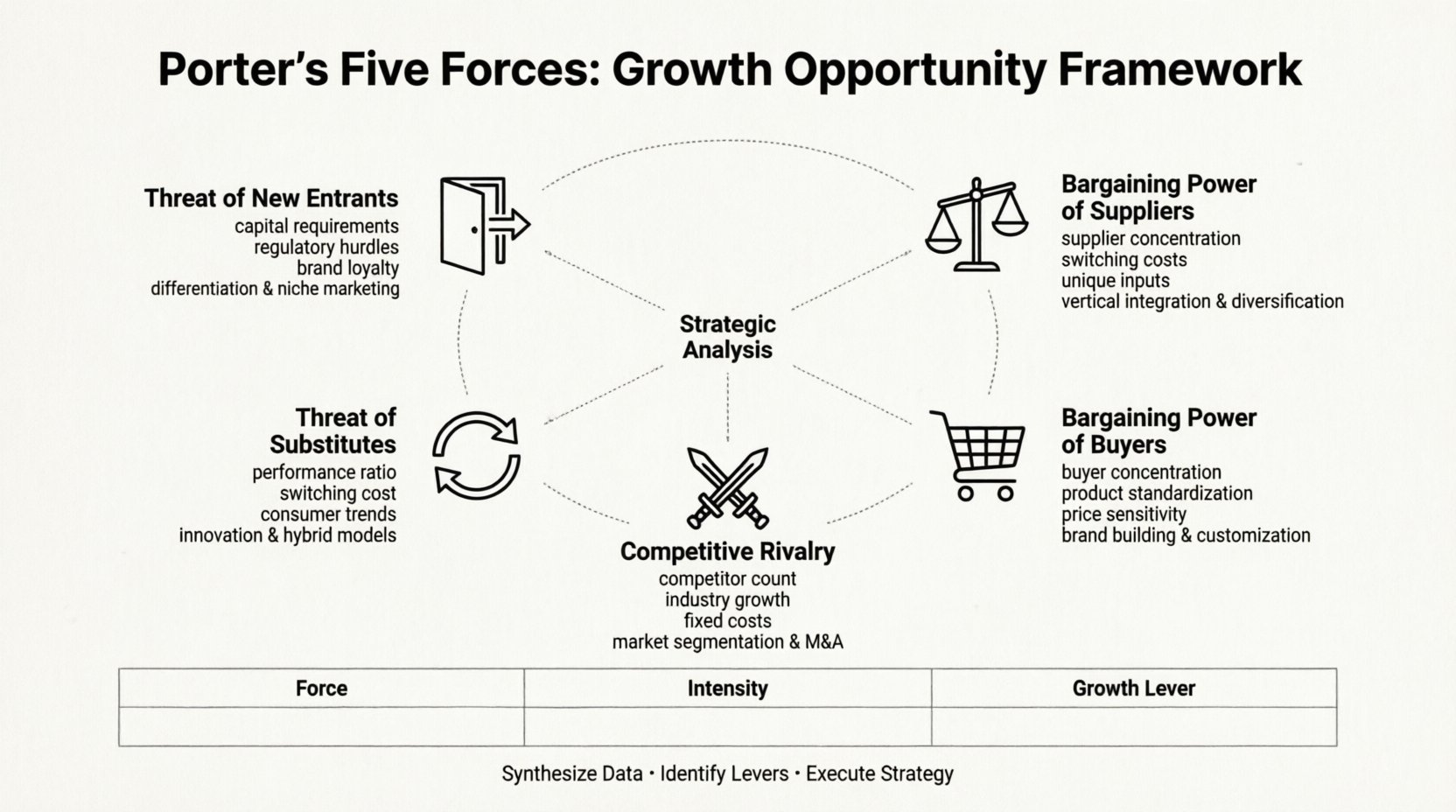
Understanding the Five Forces Framework 🧩
Developed by Michael Porter in 1979, this model assesses the competitive environment through five distinct forces. These forces determine the intensity of competition and the overall attractiveness of an industry. By analyzing each force, consultants can identify where margins are being squeezed and where leverage exists for expansion.
The framework is not static. It evolves with technological shifts, regulatory changes, and consumer behavior. Consultants use it as a diagnostic tool to map the current state of an industry and project future trajectories. The goal is not merely to describe the competition but to find leverage points where a business can differentiate itself or optimize its position.
- Industry Structure: Understanding how value is created and distributed.
- Competitive Intensity: Measuring the pressure on pricing and margins.
- Strategic Positioning: Aligning internal capabilities with external realities.
Effective analysis requires quantitative data and qualitative insights. Consultants gather information from financial reports, customer feedback, and supply chain interactions. This multi-faceted approach ensures a comprehensive view of the market dynamics.
Force 1: Threat of New Entrants 🚪
The threat of new entrants refers to the ease with which new competitors can enter the market. High barriers to entry protect existing players, while low barriers invite disruption. Consultants analyze this force to determine if the market is saturated or if there is room for new players to capture share.
Key Indicators
- Capital Requirements: High startup costs often deter new competitors.
- Regulatory Hurdles: Licenses, patents, and compliance standards.
- Access to Distribution: Securing retail space or online channels.
- Brand Loyalty: Established customer trust creates a moat.
Growth Opportunities
When the threat of entry is low, existing businesses can focus on optimizing operations and raising prices. However, if barriers are low, the growth opportunity lies in differentiation. A consultant might advise a client to build strong intellectual property or create high switching costs for customers.
Conversely, if a client wishes to enter a market where barriers are high, they must find a niche. For example, targeting a specific demographic that larger competitors overlook can reduce the risk of direct confrontation. Consultants help clients identify these underserved segments.
- Patent Acquisition: Secure proprietary technology.
- Niche Marketing: Focus on specific customer needs.
- Strategic Partnerships: Leverage existing networks for distribution.
Force 2: Bargaining Power of Suppliers ⚖️
Suppliers play a critical role in determining the profitability of an industry. When suppliers have significant power, they can raise prices or reduce quality, squeezing the margins of downstream companies. Consultants evaluate this force to understand supply chain vulnerabilities and cost structures.
Key Indicators
- Supplier Concentration: Few suppliers mean higher power.
- Switching Costs: Difficulty in changing providers.
- Uniqueness of Input: Specialized materials or services.
- Threat of Integration: Suppliers entering the market.
Growth Opportunities
High supplier power often leads to cost instability. A primary growth strategy involves vertical integration. By acquiring suppliers, a company gains control over costs and supply continuity. This reduces dependency on external entities and improves margin stability.
Alternatively, consultants may recommend diversifying the supplier base. Relying on a single source creates risk. Expanding the network allows for better negotiation leverage. If a supplier raises prices, the client can pivot to another vendor without significant disruption.
- Vertical Integration: Acquire upstream partners.
- Supplier Diversification: Reduce reliance on single sources.
- Long-term Contracts: Lock in favorable pricing terms.
Force 3: Bargaining Power of Buyers 🛒
Buyers determine the price sensitivity of the market. When buyers have high power, they demand lower prices or higher quality. This force is particularly relevant in industries with many competitors and undifferentiated products.
Key Indicators
- Buyer Concentration: Few large customers buying in volume.
- Product Standardization: Lack of differentiation increases price sensitivity.
- Switching Costs: Ease of moving to a competitor.
- Price Sensitivity: How much buyers care about cost.
Growth Opportunities
To mitigate buyer power, consultants often suggest product differentiation. If a product is unique, buyers cannot easily switch. Building a strong brand can also reduce price sensitivity. Customers willing to pay a premium for perceived value grants the business more pricing flexibility.
Another strategy is to increase switching costs. This can be achieved through loyalty programs, integrated software ecosystems, or customized service levels. When the cost of leaving is high, buyers are less likely to negotiate aggressively.
- Brand Building: Create emotional connection and trust.
- Customization: Tailor solutions to specific client needs.
- Value-Added Services: Offer support beyond the core product.
Force 4: Threat of Substitute Products 🔄
Substitutes are products from outside the industry that satisfy the same need. For example, video conferencing is a substitute for business travel. The availability of substitutes limits the price a company can charge and caps potential revenue.
Key Indicators
- Performance of Substitute: Does it work as well?
- Price-Performance Ratio: Is it cheaper or better?
- Switching Cost: How hard is it to switch?
- Consumer Preference: Are trends shifting?
Growth Opportunities
Understanding substitutes allows businesses to innovate. If a substitute is gaining traction, the current business model may be at risk. Consultants help clients identify these trends early. Adaptation might involve improving the core offering or integrating features from the substitute category.
For instance, if streaming services threaten traditional cable, a cable company might launch its own digital platform. This turns a threat into a growth channel. By embracing the technology, the company retains its customer base rather than losing them to the alternative.
- Innovation: Improve product performance to stay ahead.
- Hybrid Models: Combine physical and digital offerings.
- Education: Show customers why the original product is superior.
Force 5: Competitive Rivalry 🥊
This force represents the intensity of competition among existing firms. High rivalry often leads to price wars, advertising battles, and innovation races. In some industries, rivalry is mild due to cooperation or market segmentation.
Key Indicators
- Number of Competitors: More competitors increase rivalry.
- Industry Growth Rate: Slow growth leads to fighting for share.
- Fixed Costs: High fixed costs pressure firms to utilize capacity.
- Exit Barriers: Difficulty leaving the market increases competition.
Growth Opportunities
In highly competitive markets, differentiation is key. Consultants look for areas where competitors are weak. This might be customer service, delivery speed, or technical support. By excelling in these areas, a business can command a premium.
Consolidation is another avenue. Merging with or acquiring a competitor can reduce rivalry and increase market share. This requires careful analysis of regulatory approval and cultural fit. Successful consolidation can lead to economies of scale and improved profitability.
- Market Segmentation: Focus on niche areas.
- Operational Efficiency: Reduce costs to sustain lower prices.
- Mergers and Acquisitions: Consolidate market position.
Synthesizing Data for Strategic Action 📊
Once the five forces are analyzed, the data must be synthesized into a coherent strategy. Consultants use matrices and scoring systems to weigh the impact of each force. This helps prioritize which areas require immediate attention.
| Force | Intensity Level | Primary Growth Lever |
|---|---|---|
| New Entrants | Low | Price Optimization |
| Suppliers | High | Vertical Integration |
| Buyers | Medium | Brand Differentiation |
| Substitutes | High | Innovation |
| Rivalry | Medium | Cost Leadership |
This table illustrates how different force intensities dictate specific strategic responses. A high intensity in one area often requires a counter-balancing strength in another. For example, if supplier power is high, cost leadership becomes difficult. Differentiation must then be the focus to justify higher costs.
Common Pitfalls in Analysis 🚫
Even experienced professionals can make errors when applying this framework. Recognizing these pitfalls ensures the analysis remains accurate and useful.
- Static Analysis: Treating the industry as unchanging. Markets shift rapidly.
- Ignoring Substitutes: Focusing only on direct competitors. True threats come from unexpected sources.
- Overconfidence: Assuming internal strength negates external threats.
- Lack of Data: Relying on assumptions rather than verified information.
Consultants mitigate these risks by using multiple data sources. They validate assumptions through interviews and market testing. Continuous monitoring ensures the strategy remains relevant as conditions change.
Integrating with Other Strategic Tools 🔗
Porter’s Five Forces is rarely used in isolation. It pairs well with other frameworks to provide a holistic view. Combining it with SWOT analysis helps align external threats with internal strengths and weaknesses.
When integrated with the Value Chain analysis, consultants can see exactly where costs are incurred and where value is added. This combination reveals specific operational improvements that support the broader strategic direction.
- SWOT Analysis: Matches internal capabilities to external forces.
- PESTLE Analysis: Adds macro-environmental context.
- BCG Matrix: Helps allocate resources across product lines.
This multi-framework approach ensures that growth opportunities are not just identified but are feasible given the organization’s resources and capabilities. It prevents the selection of strategies that look good on paper but fail in execution.
Real-World Application Scenarios 🌍
To illustrate the practical application, consider a manufacturing firm looking to expand. The consultant first assesses the threat of new entrants. If technology is expensive to replicate, the firm can invest in R&D to widen the gap.
Next, they analyze supplier power. If raw material prices are volatile, the firm might secure long-term contracts or source from alternative regions. This stabilizes the cost base.
Then, buyer power is examined. If clients demand lower prices, the firm introduces premium versions of their product. This captures customers willing to pay for quality while retaining price-sensitive clients with standard options.
Finally, they review substitutes. If digital alternatives exist, the firm enhances physical durability or offers hybrid services. This creates a comprehensive defense against market shifts.
Implementation Steps for Consultants 🛠️
Executing an analysis involves a structured process. Consultants follow a specific workflow to ensure consistency and accuracy.
- Define the Industry: Clearly outline the scope and boundaries.
- Gather Data: Collect financial reports, customer surveys, and industry news.
- Assess Each Force: Evaluate the intensity of each of the five forces.
- Identify Trends: Look for shifts in technology or regulation.
- Develop Strategies: Formulate actions based on the findings.
- Monitor Results: Track the impact of implemented strategies.
This process ensures that every decision is backed by evidence. It reduces the risk of strategic drift and keeps the organization focused on high-value activities.
The Role of Data in Modern Analysis 📉
Today, data availability has transformed how consultants conduct this analysis. Large datasets allow for more precise modeling of market trends. Quantitative methods complement qualitative insights to provide a clearer picture.
However, data is not a substitute for judgment. Context matters. A spike in prices might indicate inflation or a supply shortage. Understanding the cause is essential for determining the right response. Consultants rely on their experience to interpret data correctly.
- Market Research: Primary and secondary sources.
- Financial Modeling: Forecasting future scenarios.
- Competitor Intelligence: Monitoring competitor moves.
The integration of data and expertise creates a robust foundation for decision-making. It allows businesses to move forward with confidence, knowing that their strategy is grounded in reality.
Conclusion on Strategic Execution
Utilizing Porter’s Five Forces provides a disciplined method for evaluating growth potential. It forces leaders to look beyond internal operations and consider the broader ecosystem. By understanding the pressures from suppliers, buyers, competitors, and substitutes, businesses can position themselves for sustainable success.
The framework is a tool, not a crystal ball. It requires active management and regular updates. As markets evolve, so must the analysis. Consultants who master this process help their clients navigate complexity and seize opportunities that others miss.
Ultimately, the value lies in the insights gained. These insights drive action. Whether it is entering a new market, launching a product, or optimizing costs, the Five Forces provide the map. With a clear path identified, organizations can execute with precision and achieve their growth targets.