
In modern enterprise architecture, the disconnect between high-level strategy and day-to-day execution often leads to wasted resources and unclear outcomes. Establishing a clear line of sight from organizational intent to specific technical requirements is not just a best practice; it is a necessity for sustainable growth. This guide explores how to build robust traceability using the Business Motivation Model (BMM) to ensure every requirement serves a defined purpose. 🏗️
Introduction to Strategic Alignment 📊
Organizations frequently struggle with the “why” behind their projects. Teams may execute tasks efficiently but fail to address the underlying business drivers. Without a structured approach, requirements become isolated artifacts rather than components of a cohesive strategy. The Business Motivation Model provides a standardized framework to bridge this gap. It allows stakeholders to visualize how motivation drives action, and how action translates into measurable results. 🚀
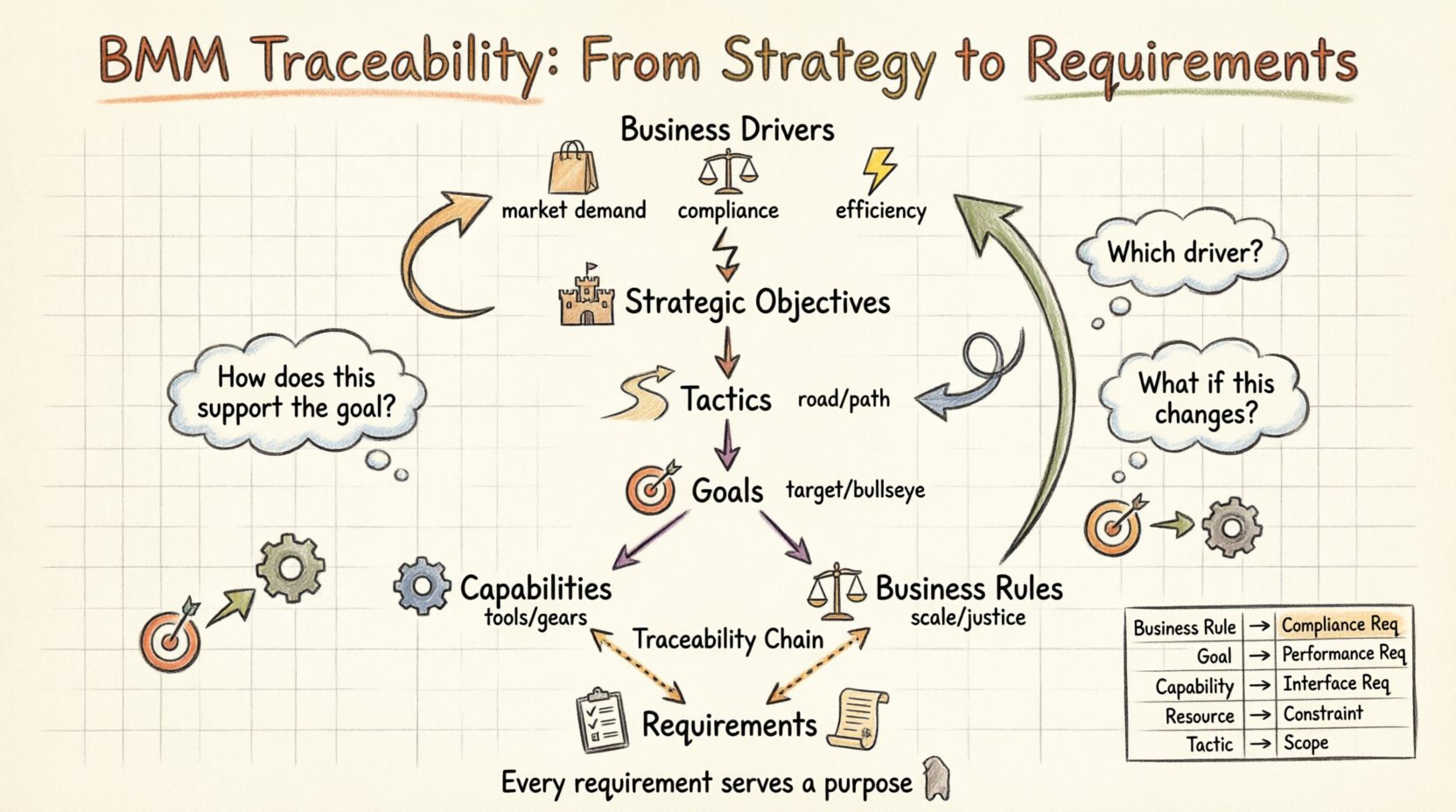
Traceability in this context means the ability to track the origin and impact of every requirement. It answers critical questions:
Which business driver necessitates this feature?
How does this requirement support a specific goal?
What is the impact of changing this requirement on the overall strategy?
By integrating traceability early, teams reduce technical debt and ensure that software development aligns with organizational values. This process moves beyond simple documentation; it creates a living map of business intent. 🗺️
The Core of Business Motivation Model 🧠
The Business Motivation Model (BMM) is an OMG standard designed to capture the reasons behind business decisions. It structures the relationship between what an organization wants to achieve and how it plans to get there. Understanding the core elements is the first step toward effective traceability.
Key BMM Components
To build traceability, one must understand the hierarchy of motivation. The model distinguishes between different types of elements:
Strategic Objectives: High-level goals that define the direction of the enterprise. These are often long-term and stable. 🏛️
Tactics: Specific plans or approaches taken to achieve strategic objectives. These are more flexible than objectives. 🛣️
Goals: Measurable targets that support tactics. They provide a clear definition of success. 🎯
Business Rules: Constraints or conditions that must be met. These define the boundaries of operations. ⚖️
Capabilities: The abilities required to execute tactics. These often map directly to system functions. 🛠️
Resources: The assets needed to support capabilities. This includes people, technology, and budget. 💰
Each of these elements plays a distinct role in the chain of command from vision to implementation. When requirements are written, they must be linked back to these specific nodes. A requirement derived from a capability is different from one derived from a business rule. Recognizing this distinction ensures precision in development. 🔍
Defining the Traceability Chain 🔗
Traceability is not a linear path; it is a network of relationships. Building this network requires a systematic approach to linking BMM elements to requirements. The goal is to create a bidirectional flow where changes in strategy reflect in requirements, and changes in requirements reflect on strategic impact.
Steps to Establish the Chain
Identify the Business Drivers: Start by documenting the external or internal forces motivating the project. Is it regulatory compliance, market demand, or efficiency? 🔎
Map to Strategic Objectives: Align these drivers to high-level objectives. Ensure there is no orphaned driver without a supporting goal. 📈
Define Tactics and Goals: Break down objectives into actionable plans. Set specific, measurable goals for each tactic. 📝
Link Capabilities to Requirements: Translate goals into the capabilities needed. Then, derive specific requirements that enable these capabilities. ⚙️
Validate the Link: Review the chain to ensure no breaks exist. Every requirement should have a parent goal, and every goal should have supporting requirements. ✅
This process requires collaboration between business analysts, architects, and developers. It is not a task for a single department. Shared understanding is the glue that holds the traceability chain together. 🤝
Mapping Elements to Requirements 📝
Different types of requirements stem from different parts of the BMM. Understanding the source helps in prioritizing and managing the requirements throughout the lifecycle. For instance, a requirement derived from a Business Rule is non-negotiable, whereas one derived from a Goal might be adjustable based on performance data.
The following table outlines how BMM elements typically map to requirement types.
BMM Element | Requirement Type | Example |
|---|---|---|
Business Rule | Functional / Compliance | System must validate user age before access. |
Goal | Functional / Performance | System must process 1000 transactions per second. |
Capability | System Interface | System must expose API for inventory lookup. |
Resource | Non-Functional / Constraint | System must run on existing hardware infrastructure. |
Tactic | Strategic / Project Scope | Launch mobile application by Q3. |
Using this mapping, teams can categorize requirements based on their strategic weight. This aids in decision-making when resources are limited. If a conflict arises, the origin element in the BMM indicates which requirement carries more strategic importance. 🏆
Managing Changes and Evolution 🔄
Business environments are dynamic. A strategy that is valid today may be obsolete tomorrow. The traceability model must be resilient enough to handle change without losing context. When a goal changes, the impact on requirements must be assessed immediately.
Impact Analysis
When a Strategic Objective shifts, the following steps should be taken:
Identify Affected Goals: Find all goals dependent on the changed objective. 🎯
Trace Downwards: List all capabilities and requirements linked to those goals. 📉
Assess Cost and Risk: Determine the effort required to update the requirements. Evaluate the risk of not updating them. ⚖️
Update Documentation: Revise the traceability links to reflect the new state. 📄
This proactive approach prevents the accumulation of “zombie requirements”—items that no longer serve a purpose but remain in the backlog. Maintaining a clean traceability chain ensures the development team always works on value-driven tasks. 💎
Common Challenges in Alignment 🛑
Despite the clear benefits, implementing BMM traceability faces several hurdles. Awareness of these challenges helps teams navigate them effectively.
1. Ambiguity in Intent
Business drivers are often vague. Phrases like “improve customer satisfaction” lack the specificity needed for requirement derivation. To counter this, analysts must work with stakeholders to quantify intent. Instead of “improve,” use “reduce response time by 20%.” 📏
2. Siloed Information
When business and IT teams operate in isolation, the traceability chain breaks. Business needs are documented in one repository, while requirements live in another. Integration of these data sources is essential. Centralized management tools help maintain a single source of truth. 🏢
3. Over-Engineering the Model
Creating a BMM map for every minor detail can become unmanageable. Focus on high-value drivers and critical goals. Granularity should match the complexity of the project. A small project does not need a complex hierarchy. ⚖️
4. Resistance to Change
Stakeholders may resist updating requirements when goals shift. They prefer stability. It is important to communicate that maintaining alignment is more valuable than maintaining static documents. The cost of misalignment is higher than the cost of change. 📉
Best Practices for Maintenance 🛡️
Once the traceability chain is built, it requires ongoing care. Regular reviews ensure the links remain valid. Consider these practices:
Regular Audits: Schedule quarterly reviews of the BMM model and requirement links. 🔍
Version Control: Treat requirements and BMM elements as versioned assets. Track changes over time. 📂
Stakeholder Engagement: Involve business owners in requirement reviews to validate alignment. 🗣️
Automated Checks: Where possible, use tooling to flag orphaned requirements or broken links. ⚙️
These practices turn traceability from a one-time task into a continuous discipline. It becomes part of the organizational culture rather than a compliance checkbox. 🏛️
Measuring Success 📊
How do you know if your traceability implementation is working? Look for specific indicators of alignment and efficiency.
Requirement Rework Rate: A decrease in rework indicates requirements match the intent better. 📉
Project Visibility: Stakeholders can easily explain why a feature exists. 🗣️
Decision Speed: Decisions on scope changes are made faster because impact is clear. ⏱️
Delivery Accuracy: The final product matches the original business vision. 🎯
Tracking these metrics provides evidence of the value gained from the Business Motivation Model approach. It justifies the effort invested in building and maintaining the traceability framework. 💪
Conclusion and Next Steps 🚀
Building traceability from goals to requirements using the Business Motivation Model is a strategic investment. It clarifies intent, reduces waste, and aligns execution with vision. While the process requires discipline and collaboration, the result is a more resilient and responsive organization. By following the structured steps outlined above, teams can ensure that every line of code serves a defined business purpose. The path forward involves starting small, validating the links, and expanding the model as the organization matures. 🌱
Remember that the model is a tool for thinking, not just a document. Use it to facilitate conversation and understanding. When everyone understands the “why,” the “how” becomes much easier to solve. 🧩