
In the landscape of software development, the demand for maintainable and scalable systems is constant. Developers and architects frequently face the challenge of writing code that functions correctly today and remains adaptable tomorrow. This is where the discipline of Object-Oriented Analysis and Design (OOAD) becomes critical. By adhering to established Object-Oriented Principles, engineers can construct reusable components that reduce redundancy and enhance system stability.
Reusability is not merely about copying and pasting code blocks. It is about creating abstractions that encapsulate logic, manage state, and define clear interfaces. This guide explores how to leverage core Object-Oriented concepts to build robust components. We will examine Encapsulation, Inheritance, Polymorphism, and the SOLID principles without relying on specific tools or languages. The focus remains on the structural integrity and logical design patterns that drive effective software engineering.
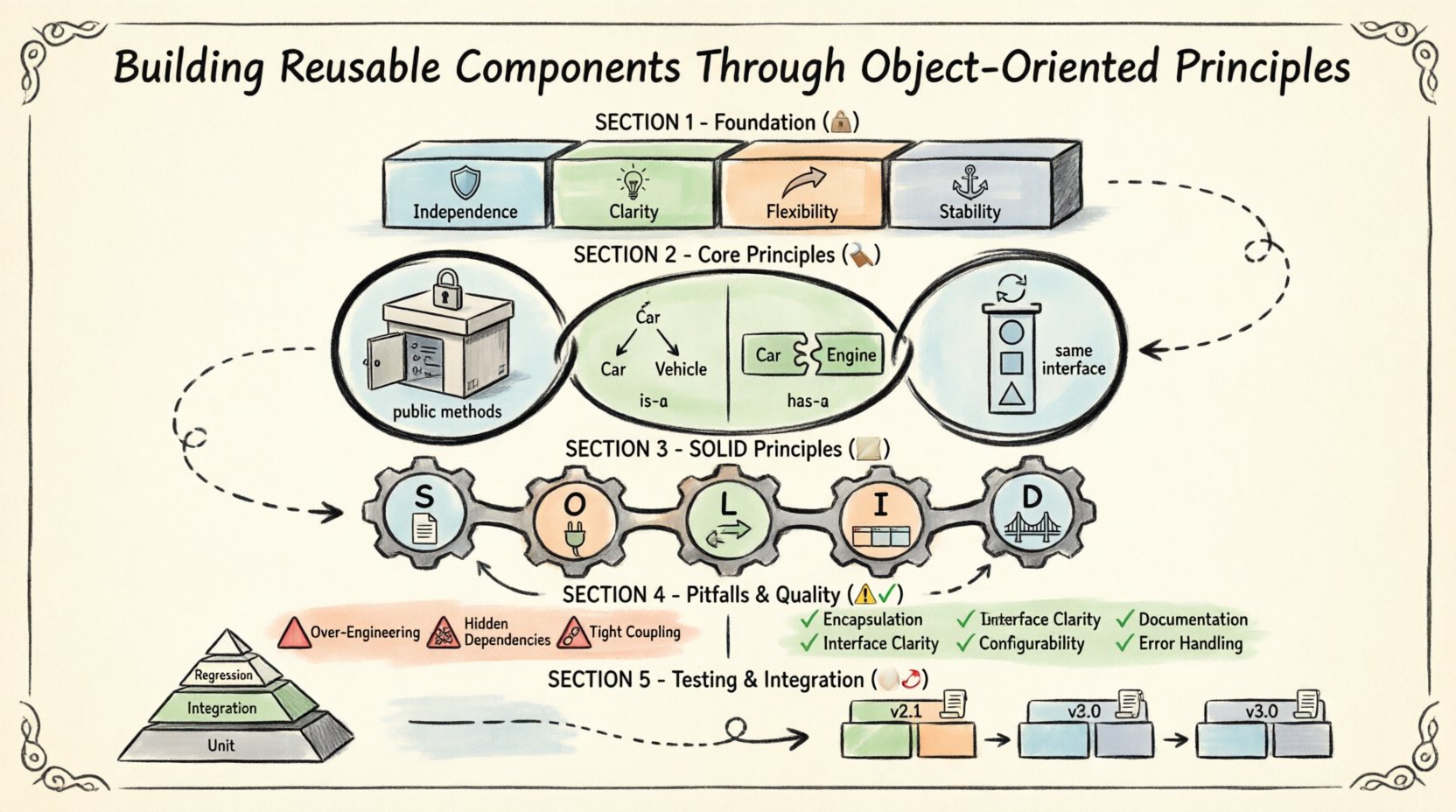
Understanding the Foundation of Reusability 🧱
Before diving into specific mechanisms, it is essential to define what constitutes a reusable component. A component is a self-contained unit of functionality that can be deployed independently or integrated into a larger system. For a component to be truly reusable, it must exhibit the following characteristics:
- Independence: The component should not rely on the internal state of other components to function.
- Clarity: Its purpose and interface must be immediately understandable to other developers.
- Flexibility: It should handle variations in input and context without breaking.
- Stability: Changes within the component should not necessitate changes in the consuming code.
Object-Oriented Analysis and Design provides the theoretical framework to achieve these characteristics. By modeling real-world entities or abstract concepts into objects, developers create a blueprint that mirrors the complexity of the problem domain. This mapping allows for the creation of components that are logical extensions of the system’s requirements.
Core Principles for Component Design 🛠️
To build components that stand the test of time, specific design principles must be applied. These principles guide the creation of classes and objects that interact cleanly. The following sections detail the primary pillars of Object-Oriented programming that facilitate reusability.
1. Encapsulation: Protecting Internal State 🔒
Encapsulation is the mechanism by which data and methods are bundled together. It restricts direct access to some of an object’s components, preventing unintended interference. For reusable components, this is vital because it ensures that the internal logic remains hidden from the outside world.
When a component exposes only necessary methods (public interface) while keeping data private, it allows for internal refactoring without affecting the system. This decoupling is the first step toward reusability. Consider the following benefits:
- Controlled Access: Prevents external code from setting invalid states.
- Implementation Hiding: The consumer does not need to know how a calculation is performed, only that it works.
- Debugging Efficiency: Issues are isolated within the component boundaries.
Without encapsulation, a component becomes fragile. Any change in variable names or internal logic would require updates across every file that accesses those variables directly. Encapsulation creates a contract between the component and the rest of the application.
2. Inheritance and Composition: Extending Functionality 🌿
Inheritance allows a new class to adopt the properties and behaviors of an existing class. This promotes code reuse by allowing common logic to be written once in a base class. However, modern design philosophy often favors Composition over Inheritance to achieve flexibility.
Inheritance creates an “is-a” relationship. A Car is a Vehicle. This is useful for sharing common attributes but can lead to deep hierarchy trees that are hard to maintain.
Composition creates a “has-a” relationship. A Car has an Engine. By composing objects together, developers can swap behaviors dynamically at runtime. This approach is generally preferred for building reusable components because it avoids the tight coupling inherent in deep inheritance hierarchies.
Key distinctions include:
- Flexibility: Composition allows behavior changes without altering the class structure.
- Testing: Composed objects can be mocked or stubbed more easily than inherited methods.
- Complexity: Composition distributes logic across multiple objects, keeping individual classes small and focused.
3. Polymorphism: Flexible Interfaces 🔄
Polymorphism allows objects of different types to be treated as objects of a common super-type. This is achieved through method overriding or interface implementation. For reusable components, polymorphism is the key to writing generic code that works with specific implementations.
When a component expects an interface rather than a concrete class, it can accept any object that satisfies that contract. This enables the following advantages:
- Interchangeability: One implementation can be swapped for another without changing the consumer code.
- Extensibility: New types can be added without modifying existing logic.
- Abstraction: The consumer interacts with a high-level abstraction, ignoring low-level details.
This principle is fundamental when designing systems that must evolve. It ensures that the architecture remains stable even as new requirements introduce new types of data or logic.
Applying SOLID Principles for Maintainability 📐
The SOLID acronym represents five design principles intended to make software designs more understandable, flexible, and maintainable. Applying these principles ensures that reusable components are not just functional, but robust.
Single Responsibility Principle (SRP)
A class should have only one reason to change. If a component handles both data validation and database storage, it is harder to reuse. One part of the system might need validation, while another needs storage. Separating these concerns ensures the component can be used in different contexts.
Open/Closed Principle (OCP)
Entities should be open for extension but closed for modification. You should be able to add new functionality by adding new code, not by changing existing code. This is achieved through interfaces and abstract classes. When a component is open for extension, developers can create subclasses or new implementations to meet new needs without risking the stability of the original logic.
Liskov Substitution Principle (LSP)
Subtypes must be substitutable for their base types. If a component expects a base type, any subtype provided must work correctly without altering the expected behavior. Violating this leads to runtime errors when a specific implementation behaves unexpectedly. This principle ensures that inherited logic does not introduce side effects.
Interface Segregation Principle (ISP)
Clients should not be forced to depend on methods they do not use. Large, monolithic interfaces are difficult to reuse because they carry unnecessary baggage. By creating small, specific interfaces, components can implement only the methods they require. This reduces coupling and makes the interface easier to understand.
Dependency Inversion Principle (DIP)
High-level modules should not depend on low-level modules. Both should depend on abstractions. This decouples the component from specific implementations. By depending on an interface, a component can work with any implementation that satisfies the contract. This is essential for testing and for integrating different parts of a system.
Common Pitfalls and How to Avoid Them ⚠️
Even with a solid understanding of principles, mistakes occur during the design phase. Recognizing these common pitfalls helps in creating better reusable components.
- Over-Engineering: Designing a component to handle every possible scenario before it is needed creates unnecessary complexity. Build for the current requirements and add flexibility only when patterns emerge.
- Hidden Dependencies: If a component relies on global state or static variables, it becomes difficult to test and reuse. Explicitly pass dependencies as arguments.
- Leaking Abstractions: Exposing internal implementation details in the public interface breaks encapsulation. Keep the internal data structures private.
- Violation of SRP: Making a “God Class” that does everything. Split responsibilities into smaller, focused classes.
- Tight Coupling: Relying on concrete classes instead of interfaces. Always program to an abstraction.
Evaluating Component Quality for Reuse ✅
Before declaring a component reusable, it must undergo a review process. This evaluation ensures the component meets the standards required for integration into different systems. The following checklist can be used for assessment:
| Criteria | Question | Impact |
|---|---|---|
| Encapsulation | Is internal state protected? | High |
| Interface Clarity | Are method names descriptive? | High |
| Testability | Can it be unit tested in isolation? | Medium |
| Configurability | Does it require hardcoded values? | High |
| Documentation | Is the usage documented? | Medium |
| Error Handling | Does it handle edge cases gracefully? | High |
Components that score highly on this checklist are more likely to be adopted by other teams. They reduce the cognitive load on developers who integrate them.
Integration Strategies for Component Reuse 🔄
Once components are designed, the next challenge is integrating them into the broader system. Reusability is not a one-time effort; it requires a strategy for distribution and versioning.
- Modular Architecture: Structure the system so that components are distinct modules. This allows them to be loaded or unloaded independently.
- Versioning: When a component changes, ensure backward compatibility. If the interface changes, create a new version rather than breaking existing consumers.
- Documentation Standards: Provide clear examples of how to use the component. Code comments are insufficient; external documentation is necessary for complex logic.
- Feedback Loops: Encourage teams to report issues or suggest improvements. Reusability improves when the component evolves based on real-world usage.
The Role of Testing in Reusability 🧪
A component cannot be trusted if it is not tested thoroughly. Testing ensures that the component behaves as expected in various scenarios. For reusable components, testing is even more critical because the component will be used in contexts the original developer may not anticipate.
Unit Tests: Verify individual methods and logic flows. These tests run quickly and provide immediate feedback on changes.
Integration Tests: Verify that the component works correctly when combined with other parts of the system. This checks for interface compatibility and dependency issues.
Regression Tests: Ensure that new changes do not break existing functionality. This is vital for maintaining trust in the component over time.
Conclusion on Design Discipline 📝
Building reusable components is a discipline that requires patience and adherence to fundamental principles. By focusing on Encapsulation, Inheritance, and Polymorphism within the context of Object-Oriented Analysis and Design, developers create systems that are easier to maintain and scale. The SOLID principles provide a checklist for ensuring that the code remains clean and adaptable.
Reusability is not about saving lines of code today; it is about saving development time tomorrow. It reduces the likelihood of bugs, speeds up onboarding for new team members, and allows the architecture to evolve without structural collapse. By following these guidelines and avoiding common pitfalls, engineers can build a foundation of components that supports long-term growth and stability.
The journey toward better software architecture is continuous. Each project offers an opportunity to refine design patterns and improve component quality. With a focus on clear interfaces and strong abstraction, the resulting system will serve the organization effectively for years to come.