
Understanding the competitive environment is critical for any business operating in the retail or e-commerce sector. Michael Porter’s Five Forces framework provides a structured approach to analyzing industry attractiveness and competitive intensity. This model helps organizations identify the sources of profitability and potential risks within their market. In the digital age, where traditional brick-and-mortar stores compete directly with online platforms, the dynamics have shifted significantly.
This guide explores how to apply Porter’s Five Forces specifically to retail and e-commerce contexts. We will examine the five critical forces that shape the industry, providing actionable insights for strategic planning. By understanding these pressures, businesses can better position themselves for long-term sustainability and growth.
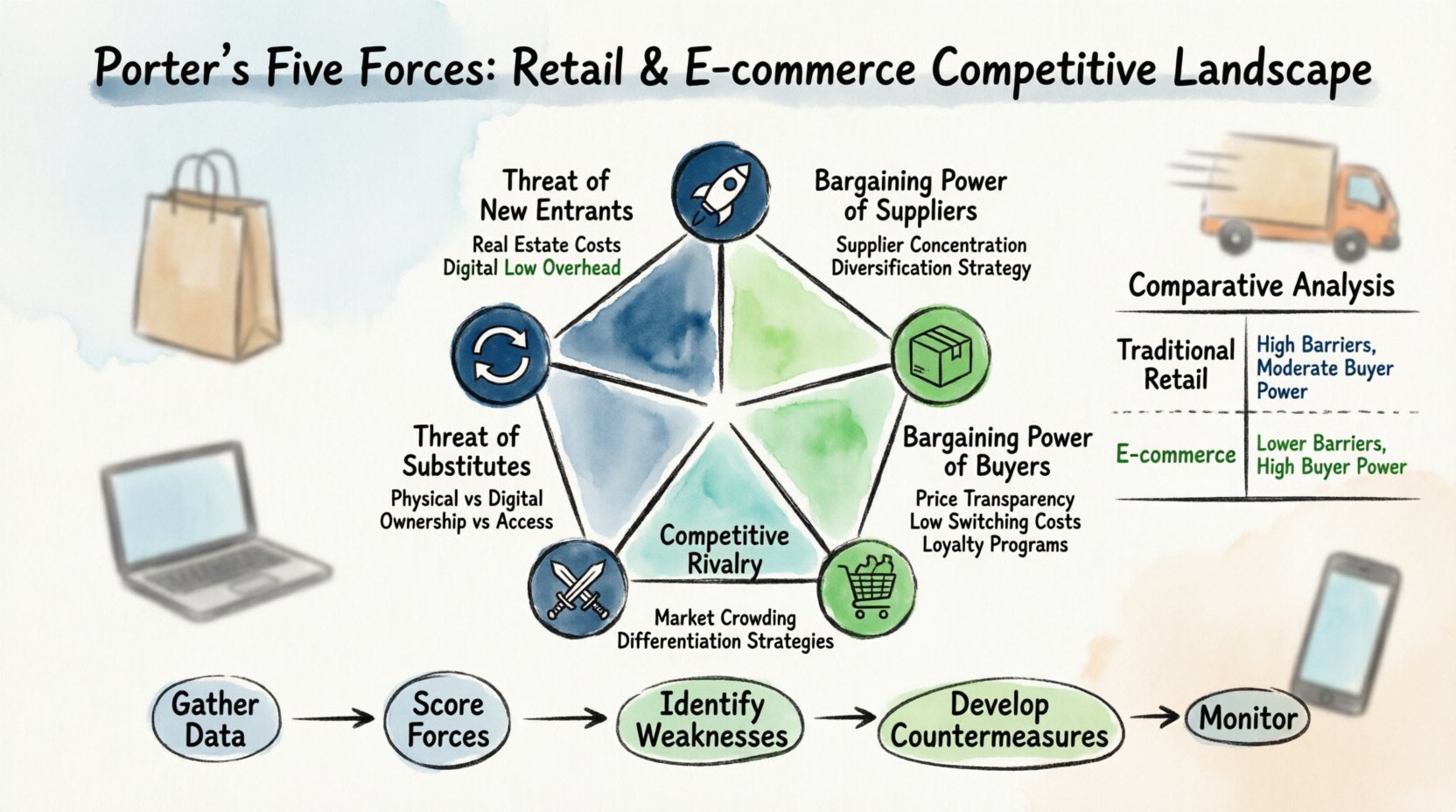
1️⃣ Understanding the Framework
Developed by Michael Porter in 1979, the Five Forces model assesses the competitive intensity and attractiveness of a market. It looks beyond direct competitors to include broader industry factors. For retail and e-commerce, this analysis is more than just a theoretical exercise; it is a practical tool for decision-making.
The framework consists of five distinct forces:
- Threat of New Entrants: How easy is it for new competitors to enter the market?
- Bargaining Power of Suppliers: How much control do suppliers have over prices and quality?
- Bargaining Power of Buyers: How much influence do customers have over pricing and terms?
- Threat of Substitute Products or Services: Are there alternative solutions to the core offering?
- Competitive Rivalry: How intense is the competition among existing firms?
When applied to retail, these forces interact in complex ways. Physical stores face different challenges compared to digital-only retailers. However, the convergence of channels (omnichannel retail) means these distinctions are becoming less clear.
2️⃣ Threat of New Entrants 🚀
The threat of new entrants refers to the ease with which new competitors can enter the industry. High barriers to entry protect existing market share, while low barriers invite competition.
Barriers in Traditional Retail
Entering the physical retail space historically required significant capital investment. Key barriers included:
- Real Estate Costs: Securing prime locations in high-traffic areas involves substantial leasing or purchasing expenses.
- Inventory Capital: Stocking shelves requires upfront investment in goods before any revenue is generated.
- Supply Chain Infrastructure: Establishing logistics networks for delivery and storage is complex.
- Brand Recognition: Building customer trust takes years of consistent performance.
Barriers in E-commerce
Digital retail has lowered many traditional barriers, changing the competitive landscape:
- Reduced Overhead: Online stores do not require physical storefronts in expensive locations.
- Global Reach: A new seller can reach a worldwide audience immediately.
- Third-Party Logistics: Fulfillment services allow small players to manage shipping without owning warehouses.
- Marketplaces: Platforms allow sellers to list products without building their own websites.
However, new digital entrants face their own hurdles:
- Customer Acquisition Costs: Digital advertising prices have risen due to high competition.
- Tech Stack Complexity: Building a secure, scalable, and user-friendly platform requires technical expertise.
- Trust and Security: Consumers are cautious about sharing payment details with unknown entities.
3️⃣ Bargaining Power of Suppliers 📦
Suppliers can influence prices and quality by controlling the availability of essential inputs. In retail and e-commerce, suppliers range from manufacturers to logistics providers.
Factors Increasing Supplier Power
- Concentration of Suppliers: If few companies control the supply of a popular product, they hold leverage.
- Uniqueness of Product: Proprietary or branded goods give suppliers pricing power.
- Switching Costs: Changing suppliers may require retooling or retraining staff.
- Threat of Forward Integration: Suppliers may decide to sell directly to consumers, bypassing retailers.
Strategies to Reduce Supplier Influence
Retailers can mitigate supplier power through several methods:
- Diversification: Sourcing from multiple suppliers across different regions reduces dependency.
- Vertical Integration: Acquiring or merging with suppliers to control the supply chain.
- Private Labeling: Developing house brands reduces reliance on established external manufacturers.
- Volume Commitments: Offering long-term purchase contracts in exchange for better pricing.
In the e-commerce sector, the rise of direct-to-consumer (DTC) brands has shifted power. Manufacturers now have the capability to sell directly to end-users, potentially cutting out the intermediary retailer.
4️⃣ Bargaining Power of Buyers 🛍️
Buyers have significant influence in the retail sector. They dictate price sensitivity and demand high service levels. The power of buyers has increased dramatically with the advent of the internet.
Drivers of High Buyer Power
- Price Transparency: Customers can compare prices instantly across multiple platforms.
- Low Switching Costs: It takes no effort to click away and buy from a competitor.
- Availability of Information: Reviews and ratings allow buyers to make informed decisions.
- Standardized Products: If products are identical, price becomes the primary differentiator.
Reducing Buyer Power
Retailers can improve their position relative to buyers by focusing on differentiation:
- Customer Loyalty Programs: Rewards systems encourage repeat purchases and increase switching costs.
- Exclusive Offerings: Offering products not available elsewhere creates value.
- Superior Service: Fast shipping, easy returns, and responsive support enhance the experience.
- Brand Equity: Strong emotional connections with customers make them less price-sensitive.
In e-commerce, the ability to personalize the shopping experience is a key tool for reducing buyer power. Tailored recommendations and curated content make the platform more valuable to the individual user.
5️⃣ Threat of Substitute Products or Services 🔄
Substitutes are products from other industries that satisfy the same need. They place a ceiling on prices because customers will switch if the price is too high.
Common Substitutes in Retail
- Physical vs. Digital: Buying a physical book vs. an e-book or audiobook.
- Ownership vs. Access: Buying a car vs. using a car-sharing service.
- Brick-and-Mortar vs. Online: Shopping in a store vs. ordering via an app.
- Different Categories: Renting clothing vs. buying it second-hand or new.
Strategic Response
To address the threat of substitutes, businesses must emphasize unique value propositions:
- Experience: Physical stores offer tactile experiences that online cannot replicate.
- Convenience: E-commerce offers speed and ease that physical stores cannot match.
- Service Integration: Combining online browsing with in-store pickup (BOPIS) bridges the gap.
- Innovation: Continuously updating product lines to stay ahead of emerging alternatives.
In the fashion industry, for example, the rise of rental services has forced retailers to rethink ownership models. Similarly, digital streaming services have substituted physical media sales.
6️⃣ Competitive Rivalry ⚔️
This force looks at the intensity of competition among existing firms. High rivalry leads to price wars, advertising battles, and innovation races.
Indicators of High Rivalry
- Number of Competitors: A crowded market increases pressure on margins.
- Market Growth Rate: Slow growth forces firms to fight for existing market share.
- Fixed Costs: High fixed costs encourage price cutting to maximize utilization.
- Product Similarity: If products are undifferentiated, competition is often based on price.
Managing Competitive Intensity
Companies can navigate intense rivalry through strategic positioning:
- Niche Focus: Targeting a specific segment reduces direct competition with giants.
- Cost Leadership: Operating efficiently allows for competitive pricing while maintaining margins.
- Differentiation: Offering unique features or branding that competitors cannot easily copy.
- Partnerships: Collaborating with other brands can expand reach without direct conflict.
In e-commerce, rivalry is often fierce. Major platforms dominate search results, making visibility difficult for smaller players. Strategies often involve search engine optimization and targeted content marketing to gain visibility organically.
7️⃣ Comparison: Traditional Retail vs. E-commerce 📊
To visualize the differences in force intensity between physical and digital retail, consider the following comparison.
| Force | Traditional Retail | E-commerce |
|---|---|---|
| New Entrants | High Barriers (Real Estate, Inventory) | Lower Barriers (Digital presence, Dropshipping) |
| Supplier Power | Moderate (Local suppliers, Bulk buying) | Variable (Global sourcing, DTC threat) |
| Buyer Power | Moderate (Limited comparison options) | High (Instant price comparison, Reviews) |
| Substitutes | Physical alternatives (Other stores) | Digital alternatives (Apps, Marketplaces) |
| Rivalry | Local/Regional focus | Global/Platform-based focus |
8️⃣ Strategic Implementation 🧭
Conducting this analysis is only the first step. The real value lies in translating findings into action.
Steps for Execution
- Gather Data: Collect information on market trends, competitor pricing, and supplier contracts.
- Score the Forces: Rate each force as High, Medium, or Low based on your specific context.
- Identify Weaknesses: Pinpoint areas where your business is vulnerable to external pressures.
- Develop Countermeasures: Create plans to mitigate high-risk forces.
- Monitor Regularly: The retail landscape changes quickly; repeat the analysis annually.
Integrating with Business Strategy
Align the insights with broader organizational goals. If supplier power is high, the strategy might focus on vertical integration. If buyer power is high, the focus might shift to loyalty programs and customer experience enhancement.
Omnichannel Considerations
Most modern retailers operate across multiple channels. The Five Forces analysis must account for the interaction between physical and digital channels. For instance, a strong online presence can reduce the threat of substitutes by offering convenience that a physical store alone cannot provide.
9️⃣ Future Trends and Adaptation 🌐
The retail landscape continues to evolve. Several trends are reshaping the five forces:
- Artificial Intelligence: AI tools are improving demand forecasting and personalization, affecting buyer power and competitive rivalry.
- Sustainability: Consumers increasingly prefer eco-friendly options, altering supplier selection criteria.
- Mobile Commerce: The dominance of mobile devices has increased the ease of price comparison, further empowering buyers.
- Supply Chain Disruptions: Global events have highlighted the need for resilient supply chains, influencing supplier relationships.
Staying agile is essential. Businesses that can adapt their strategies based on shifting force dynamics will maintain their competitive edge.
🔟 Final Considerations
Applying Porter’s Five Forces to retail and e-commerce provides a robust foundation for strategic planning. It highlights not just who your competitors are, but the structural factors driving industry profitability.
By systematically analyzing each force, businesses can identify opportunities for growth and areas of risk. Whether operating a single physical store or a global online marketplace, understanding these dynamics is essential for long-term success.
Continuous monitoring and adaptation ensure that strategies remain relevant in a fast-changing environment. The goal is not just to survive the competition but to shape the market in a way that favors your unique value proposition.
Start your analysis today. Gather your data, map out the forces, and define your path forward with clarity and confidence.