
Graduate research in computer science and software engineering often requires more than just theoretical exploration. It demands the construction of tangible solutions that adhere to rigorous standards. Object-Oriented Analysis and Design (OOA/D) serves as the backbone for these endeavors. It bridges the gap between abstract requirements and concrete implementation. For a graduate student, mastering this workflow is not merely about coding; it is about structuring thought processes to ensure scalability, maintainability, and validity within a research context.
This guide explores how to integrate OOA/D methodologies into academic projects. It focuses on the practical application of concepts like encapsulation, inheritance, and polymorphism within the constraints of a thesis or dissertation. By following a structured approach, researchers can avoid common pitfalls and produce work that withstands academic scrutiny.
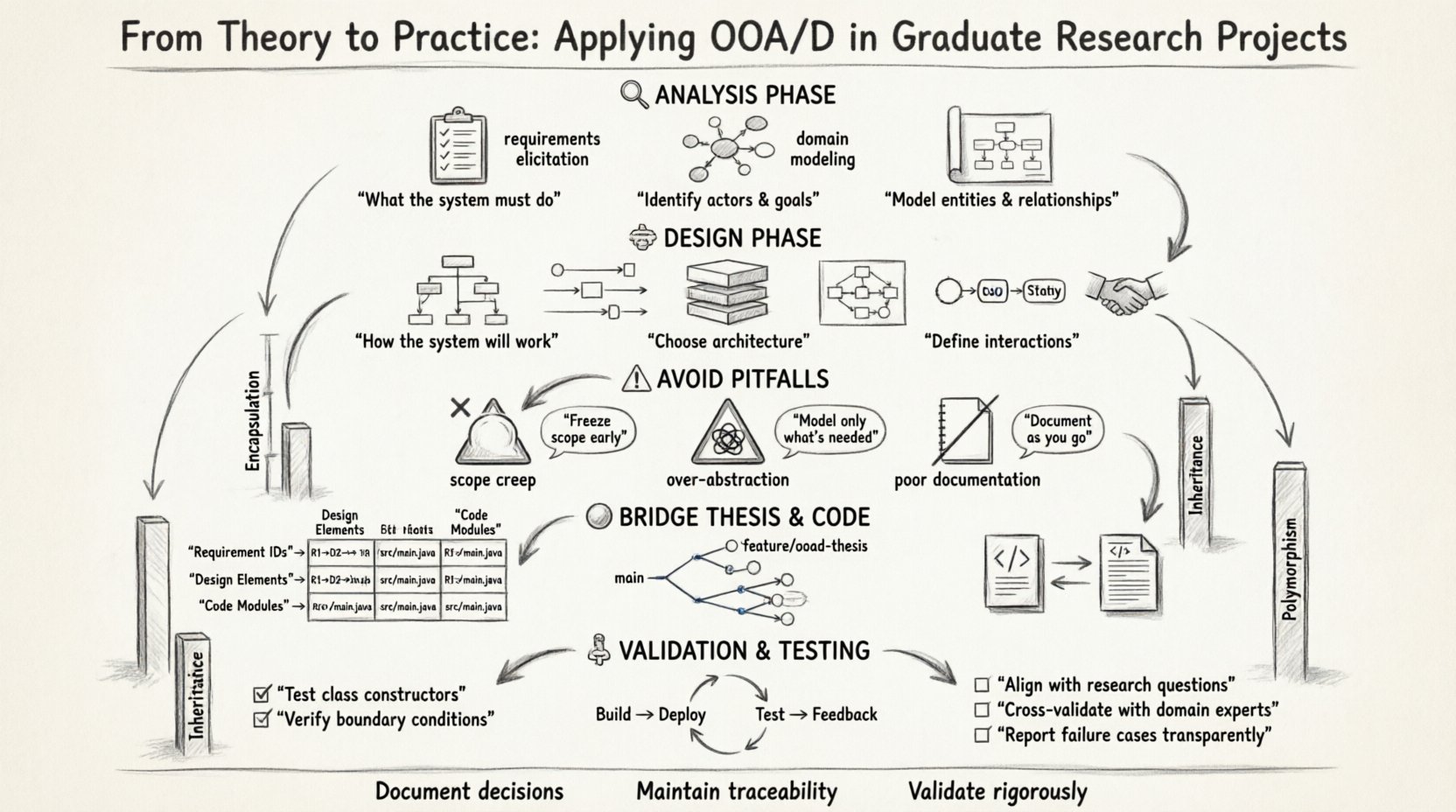
Understanding the Core Concepts of OOA/D 🧠
Before diving into the research workflow, it is essential to establish a clear understanding of the foundational pillars. Object-Oriented Analysis and Design is a structured approach to software development. It emphasizes the concept of objects, which contain both data and behavior. In the context of research, these objects represent entities within the problem domain.
When applying this to a graduate project, the focus shifts from simply building a working application to documenting the reasoning behind structural decisions. The analysis phase involves identifying the problem space. The design phase involves defining the solution space.
- Analysis: Focuses on what the system must do. It involves gathering requirements and modeling the domain.
- Design: Focuses on how the system will do it. It involves defining classes, relationships, and interactions.
- Object-Oriented Paradigm: Provides mechanisms for managing complexity through modularity.
For a research project, the documentation of these phases is as critical as the code itself. Examiners look for evidence that the system was conceived logically rather than built ad-hoc. This requires deliberate planning and clear visual representations.
Phase 1: Analysis in a Research Context 🔍
The analysis phase sets the stage for the entire project. In an academic setting, this corresponds to the literature review and problem definition sections. However, OOA/D takes this further by creating a formal model of the requirements.
1.1 Requirements Elicitation 📋
Start by defining the functional and non-functional requirements. Functional requirements describe the specific behaviors of the system. Non-functional requirements describe attributes like performance, security, and reliability. In a graduate project, these should be traceable to the research questions.
- Identify the primary actors who will interact with the system.
- Document the goals of each actor.
- Define the constraints imposed by the research environment.
Use case diagrams are a standard tool here. They map out interactions between actors and the system. This visual aid helps in validating that no critical functionality has been overlooked before a single line of code is written.
1.2 Domain Modeling 🗺️
Once requirements are clear, the next step is to model the domain. This involves identifying the key entities and their relationships. In object-oriented terms, these entities become candidate classes.
Consider the data involved in your research. If you are building a system for managing medical records, the entities might include Patient, Doctor, and Appointment. The relationships define how these entities interact. For example, a Doctor treats a Patient.
| Element | Description | Research Relevance |
|---|---|---|
| Class | A blueprint for objects | Defines data structures in your thesis |
| Attribute | Data held within a class | Maps to database fields or variables |
| Association | Relationship between classes | Defines logic flow and dependencies |
Creating a Class Diagram at this stage provides a static view of the system. It serves as a contract for the subsequent design phase. Ensure that the attributes and methods listed are necessary for the research objectives. Avoid over-engineering features that do not directly contribute to the hypothesis being tested.
Phase 2: Designing the Solution 🛠️
Design transforms the analysis models into a blueprint for implementation. This phase is where architectural decisions are made. For a graduate project, the design must be robust enough to handle the scope of the research but simple enough to be completed within the timeline.
2.1 Architectural Patterns 🏗️
Selecting the right architecture is crucial. Common patterns include Model-View-Controller (MVC), Layered Architecture, or Microservices. The choice depends on the nature of the research.
- MVC: Ideal for separating data management from user interface logic. Good for systems with complex user interactions.
- Layered: Suitable for enterprise-level systems where security and data integrity are paramount.
- Service-Oriented: Useful if the research involves distributed computing or API integration.
Document the rationale behind your choice. In a thesis, this demonstrates critical thinking. Explain why a specific pattern aligns with your research goals.
2.2 Behavioral Design 🔄
Static structure is only part of the picture. You must also define how objects interact over time. Sequence diagrams and state machine diagrams are essential here.
Sequence Diagrams: Show the flow of messages between objects. They are excellent for detailing complex logic flows. For example, how a user login process triggers a database query and a session creation.
State Machine Diagrams: Define the lifecycle of an object. If your research involves a workflow system, this is vital. It shows all possible states an entity can be in and the transitions that occur between them.
2.3 Interface Design 👥
Design the interfaces for your classes. An interface defines a contract without specifying implementation details. This promotes loose coupling, which is a key principle of object-oriented design.
- Define methods that classes must implement.
- Ensure that dependencies are minimized.
- Plan for future extensibility.
In research, this allows you to swap out components without rewriting the entire system. It adds value to the reproducibility of your work.
Common Pitfalls in Academic Projects ⚠️
Even experienced researchers make mistakes when applying OOA/D to academic projects. Recognizing these pitfalls early can save months of rework.
3.1 Scope Creep 📈
It is easy to add features during the design phase. As you build, you realize you need something else. In a graduate context, this is dangerous. The timeline is fixed. The scope must be rigid.
Mitigation Strategy: Freeze the requirements after the analysis phase. If a new requirement arises, document it as a future work item rather than implementing it immediately.
3.2 Over-Abstraction 🧩
Students often try to make their design too generic. They create interfaces for every small task. While theoretically sound, this leads to excessive complexity.
Mitigation Strategy: Apply the principle of YAGNI (You Ain’t Gonna Need It). Only create abstractions if they are required by the current research problem.
3.3 Poor Documentation 📝
A well-designed system that is poorly documented is a failure in research. The thesis must explain the design decisions clearly.
Mitigation Strategy: Write the design documentation alongside the coding. Do not treat it as an afterthought. Use diagrams to complement the text.
Bridging the Gap Between Thesis and Implementation 🌉
One of the biggest challenges in graduate research is ensuring that the written document matches the actual code. Discrepancies can lead to confusion during the defense.
4.1 Traceability Matrix 📊
Use a traceability matrix to link requirements to design elements and finally to code modules. This ensures that every requirement in your thesis has a corresponding implementation.
- Requirement ID: REQ-001
- Design Element: Class User
- Code Module: UserHandler.java
This structure provides a clear audit trail for examiners. It proves that the system was built to solve the stated problem.
4.2 Version Control for Design 📂
Just as you version your code, you should version your design diagrams. Changes in requirements should result in updated diagrams. This history is valuable for understanding the evolution of the project.
Store your diagrams in a repository alongside your code. This keeps the design and implementation synchronized.
Validation and Testing Strategies 🧪
Testing is not just about finding bugs; it is about validating the design. In OOA/D, testing often happens at the unit level, focusing on individual classes and their interactions.
5.1 Unit Testing the Design 🧩
Write tests for your classes before integrating them. This verifies that the logic within each object functions correctly in isolation. It also serves as executable documentation.
- Test boundary conditions.
- Test error handling paths.
- Verify data integrity constraints.
5.2 Integration Testing 🔄
Once units are verified, test how they work together. This validates the interactions defined in your sequence diagrams. It ensures that data flows correctly between components.
For research projects, this often involves simulating the research environment. If you are testing a network protocol, simulate network latency. If you are testing a database system, simulate high load.
Checklist for Research Validation ✅
| Check | Status | Notes |
|---|---|---|
| Requirements documented clearly | ☐ | Ensure alignment with research questions |
| Class diagrams updated | ☐ | Reflect current codebase state |
| Design rationale written | ☐ | Explain why patterns were chosen |
| Test coverage sufficient | ☐ | Validate critical paths |
| Code matches documentation | ☐ | Avoid discrepancies |
Tools and Techniques for Modeling 🛠️
While specific software products are not the focus, generic tooling is necessary. You need tools that support standard modeling languages and facilitate collaboration.
- Modeling Editors: Use tools that support industry-standard notations. These allow you to create diagrams that are easily understood by peers and examiners.
- Diagramming Software: Choose software that allows for easy export to PDF or image formats for inclusion in your thesis.
- Code Generators: Some environments allow you to generate skeleton code from your diagrams. This ensures consistency between design and implementation.
The goal is to find a workflow that minimizes friction. If the tooling hinders your progress, it is not suitable for the project. Simplicity often wins in academic settings where time is a scarce resource.
Final Thoughts on Structuring Your Work 📚
Applying Object-Oriented Analysis and Design to a graduate research project transforms the work from a simple coding exercise into a rigorous engineering study. It provides a framework for organizing complex problems and communicating solutions effectively.
By adhering to the phases of analysis and design, maintaining clear documentation, and avoiding common pitfalls, you create a robust foundation for your research. The resulting system is not only functional but also reproducible and extensible.
Remember that the objective is to contribute to knowledge. The design process itself is a form of inquiry. It forces you to question assumptions and refine your understanding of the problem domain. This intellectual rigor is what distinguishes a graduate thesis from a standard software project.
As you proceed with your research, keep the OOA/D principles in mind. They are not just rules for coding; they are principles for thinking. Use them to guide your decisions, validate your hypotheses, and structure your narrative. With a disciplined approach, you can navigate the complexities of graduate research with confidence and produce work that stands the test of scrutiny.