
Strategic planning often begins with a familiar framework: the SWOT analysis. It is a staple in boardrooms and strategy sessions worldwide. However, a standard SWOT can become a static document that sits on a shelf, disconnected from the dynamic reality of the marketplace. To truly drive value, organizations must pivot from an internal perspective to an external reality. The core of this shift lies in aligning your SWOT with market demands and, more specifically, with customer needs analysis.
When you integrate direct customer feedback into your strategic planning, you transform a theoretical exercise into a practical roadmap. This guide explores how to ground your strengths, weaknesses, opportunities, and threats in the actual behaviors, preferences, and pain points of your audience. It is about ensuring that every strategic decision is validated by the market before resources are committed.
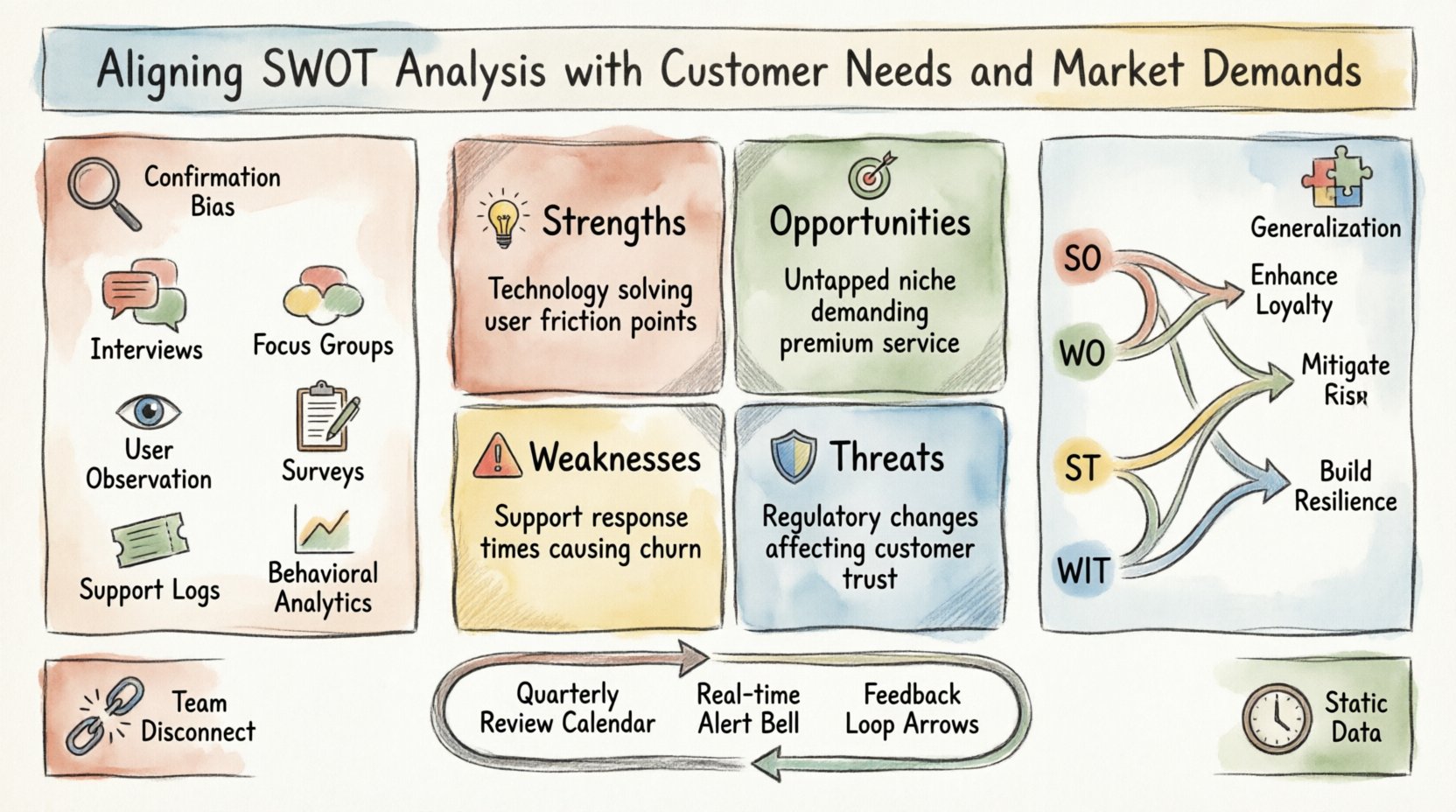
🧠 The Shift from Internal to External Focus
Many organizations suffer from a condition known as “internal echo chamber syndrome.” In this state, leaders define success based on internal metrics, such as operational efficiency or cost reduction, without verifying if these improvements actually matter to the end user. A customer-centric SWOT disrupts this cycle.
Traditional SWOT: Often relies on internal data, historical performance, and executive intuition.
Market-Aligned SWOT: Relies on real-time customer data, sentiment analysis, and observable market trends.
This distinction is critical. A strength in your internal view might be a weakness in the market if customers perceive it as outdated. Conversely, a perceived weakness in operations might be irrelevant if customers value speed over perfection. Aligning with market demands requires a rigorous audit of your internal assumptions against external validation.
📊 Decoding Customer Needs
Before mapping SWOT, you must understand the substrate upon which it rests: customer needs. These needs are not static; they evolve with technology, culture, and economic conditions. To capture them accurately, you need a multi-channel approach to data gathering.
1. Qualitative Insights
Direct Interviews: One-on-one conversations reveal the emotional drivers behind purchasing decisions.
Focus Groups: Group dynamics highlight shared frustrations and aspirations within a demographic.
User Observation: Watching how customers interact with your product or service uncovers friction points they may not articulate.
2. Quantitative Data
Surveys: Large-scale data collection on satisfaction levels and feature requests.
Support Tickets: A log of recurring issues that highlight systemic weaknesses.
Behavioral Analytics: Tracking where users drop off or engage most frequently.
Without this foundation, your SWOT analysis is built on sand. The data collected here directly feeds into the four quadrants of your strategy.
🔄 Integrating Data into the SWOT Matrix
The process of integration requires discipline. You must filter every internal finding through the lens of the customer. Does this internal capability actually solve a customer problem? Does this market trend align with what we can deliver?
Consider the following comparison between a traditional approach and a customer-aligned approach.
Component | Traditional SWOT Approach | Customer-Aligned SWOT Approach |
|---|---|---|
Strengths | We have the best technology. | We have technology that solves specific user friction points faster than competitors. |
Weaknesses | Our support team is understaffed. | Support response times are causing churn among enterprise clients. |
Opportunities | The market is growing. | Competitors are ignoring a specific niche that demands premium service. |
Threats | New regulations may appear. | Regulatory changes affect customer data privacy, impacting trust in our platform. |
This table illustrates that context matters. The “what” is the same, but the “so what” changes when customer needs are prioritized.
🛡️ Deep Dive – Strengths (S)
Strengths are internal attributes that give you an advantage over others. In a customer-aligned framework, a strength is not just a capability; it is a capability that delivers value to the user. You must ask: Do customers recognize this as a benefit?
Relevance Check: A strength in R&D is only a strength if it translates to a feature users want.
Perception Check: If your brand is known for quality but customers perceive it as expensive, the strength needs reframing.
Validation: Use testimonials and case studies to prove the strength exists in the eyes of the buyer.
When defining strengths, look for assets that reduce customer effort. If your internal process is streamlined, but the customer still faces a complex onboarding experience, that internal strength has not yet been externalized effectively.
⚠️ Deep Dive – Weaknesses (W)
Weaknesses are internal attributes that place you at a disadvantage relative to others. In the context of market demands, a weakness is any internal gap that prevents you from meeting customer expectations.
Operational Gaps: Slow delivery times, limited availability, or lack of customization.
Knowledge Gaps: Lack of understanding regarding specific customer segments or use cases.
Resource Gaps: Insufficient budget or personnel to address high-demand areas.
Crucially, do not hide weaknesses. In a customer-centric strategy, acknowledging a weakness allows you to manage expectations or pivot resources to fix it. If customers are leaving due to a specific feature gap, that is a critical weakness that must be addressed in the strategic plan.
🚀 Deep Dive – Opportunities (O)
Opportunities are external elements in the environment that, if exploited, can lead to success. Here, the market demand is the primary driver. You are looking for gaps in the market that your organization can fill.
Emerging Trends: Shifts in consumer behavior that open new avenues for growth.
Competitor Blunders: Areas where competitors are failing to meet basic customer needs.
Untapped Segments: Demographics or geographies where demand is high but supply is low.
To identify true opportunities, cross-reference market trends with your internal strengths. An opportunity is only viable if you have the capacity to pursue it. If the market demands 24/7 support and your weakness is understaffed support, that opportunity is currently out of reach until the weakness is remediated.
⚡ Deep Dive – Threats (T)
Threats are external elements that could cause trouble for the business. In a customer-aligned model, threats are often defined by the shifting expectations of the user base.
Changing Preferences: Customers moving away from your core value proposition.
Competitor Innovation: Rivals introducing features that solve customer problems better.
Regulatory Changes: Laws that impact how you deliver value to the customer.
Monitoring threats requires constant vigilance. Customer sentiment can turn quickly. A product that was beloved last year might become obsolete this year due to a shift in user behavior. Keeping your SWOT dynamic ensures you spot these threats early.
📈 The Alignment Process
Once you have populated the SWOT with customer-driven insights, the next step is alignment. This is where strategy becomes action. You need to map the four quadrants together to create a coherent plan.
Use the following framework to ensure your strategy is balanced.
Strategy Type | Focus Area | Customer Impact |
|---|---|---|
SO Strategies | Maximize Strengths, Maximize Opportunities | Deliver best-in-class solutions that satisfy high demand. |
WO Strategies | Overcome Weaknesses, Exploit Opportunities | Invest in fixes to capture new market share. |
ST Strategies | Use Strengths to Avoid Threats | Leverage brand loyalty to withstand market shifts. |
WT Strategies | Minimize Weaknesses, Avoid Threats | Protect core revenue streams during volatile times. |
Mapping Pain Points to Strategic Actions
Specific actions should be derived directly from the intersection of customer pain points and your SWOT analysis.
Identify the Pain Point: Customer reports difficulty in onboarding.
Map to SWOT: This is a Weakness (internal complexity) and a Threat (churn risk).
Strategic Action: Simplify the user interface (fix Weakness) to retain users (mitigate Threat).
🔍 Continuous Monitoring
A SWOT analysis is not a one-time event. It is a living document that requires maintenance. Market demands shift, and customer needs evolve. To keep your strategy relevant, you must establish a rhythm for review.
Quarterly Reviews: Reassess the SWOT based on the latest customer feedback data.
Real-Time Alerts: Set up notifications for major shifts in customer sentiment or support volume.
Feedback Loops: Ensure that insights from customer service teams are fed directly into the strategy team.
Without continuous monitoring, your alignment becomes stale. The market will move past your strategy before you execute it. Agility is the key to maintaining relevance.
🚫 Common Pitfalls
Even with the best intentions, organizations often stumble when trying to align SWOT with market demands. Awareness of these pitfalls can help you avoid them.
Confirmation Bias: Only looking for data that supports what leadership wants to do.
Generalization: Assuming all customers want the same thing. Segment your analysis.
Static Data: Relying on data that is older than six months.
Disconnect between Teams: Marketing knows the market, but Operations builds the product. These teams must share the SWOT.
By avoiding these traps, you ensure that your strategic planning remains grounded in reality rather than assumption.
📝 Final Thoughts
Aligning your SWOT analysis with market demands is not merely a technical exercise; it is a cultural shift. It requires humility to admit when internal strengths do not match external needs. It requires discipline to continuously gather data and update your strategic view.
When you successfully integrate customer needs into your SWOT, you create a strategy that is resilient, responsive, and relevant. You move from guessing what the market wants to knowing what they need and having the plan to deliver it. This alignment is the bedrock of sustainable growth.
Start by auditing your current SWOT. Check every item against the question: Does this matter to the customer? If the answer is no, remove it. If the answer is yes, build your strategy around it. This is how you drive deep into the heart of your market and secure your position for the future.