
Now Reading: Accelerate System Modeling: A Guide to Visual Paradigm’s AI Diagram Generation
-
01
Accelerate System Modeling: A Guide to Visual Paradigm’s AI Diagram Generation


Accelerate System Modeling: A Guide to Visual Paradigm’s AI Diagram Generation
Starting any major software design project often begins with the most daunting task: facing a blank canvas. Whether you are creating a complex UML structure or mapping out business processes, manually placing and connecting every element is time-consuming and challenging. To combat this friction, Visual Paradigm has introduced a revolutionary AI Diagram Generation feature.
This powerful tool allows users to transform a simple topic or system description, written in plain language, into a structured, well-laid-out diagram instantly. This capability accelerates your initial design phase, letting you focus on refining logic rather than drawing lines. This guide explores how to leverage Visual Paradigm’s AI to make system modeling faster and smarter.
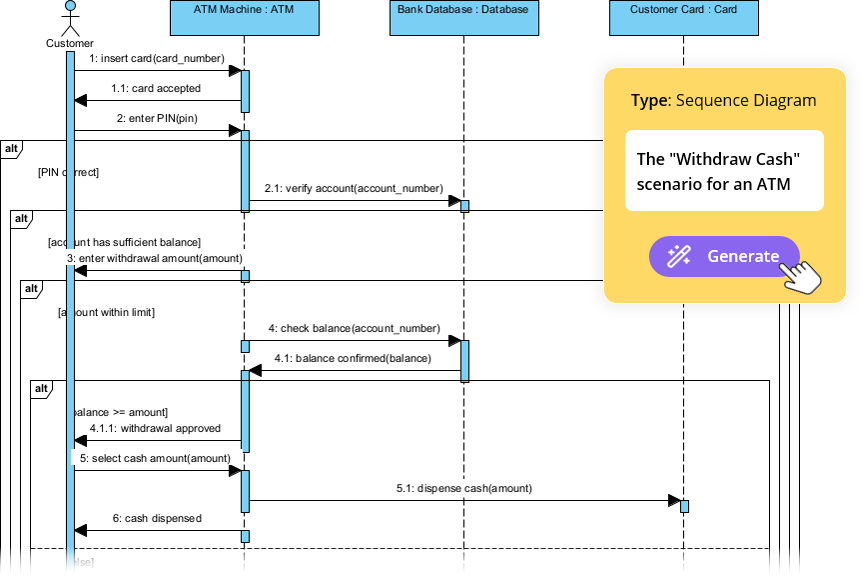
What is Visual Paradigm’s AI Diagram Feature?
The AI Diagram Generation feature leverages advanced natural language processing (NLP) to understand the entities, concepts, and relationships within your text input. Unlike basic drawing assistants, this tool performs intelligent analysis to generate meaningful artifacts.

Key advantages include:
- Intelligent Analysis: The AI processes your topic and applies core modeling standards (such as UML rules) to determine the necessary elements and connections.
- Native Output: The generated output is not a static image, but a fully editable, native Visual Paradigm diagram file. This means you can immediately manipulate elements, change styles, and continue modeling without any conversion steps.
- Automatic Layout: A major benefit is the AI’s ability to ensure a high-quality layout right from the start. This saves hours of manual alignment and repositioning, delivering a professional diagram instantly.
Step-by-Step: How to Generate Diagrams with AI
Follow these four essential steps to transform text descriptions into visual models using Visual Paradigm.
Step 1: Launching the AI Diagram Generator
To begin, you need to access the feature from the main application interface. Navigate to the top menu bar:
Go to Tools > AI Diagram
A dedicated popup window will appear, ready to accept your instructions. This interface is the command center for your AI-assisted modeling.
Step 2: Selecting the Target Diagram Type
Before providing the text, you must specify the context for the AI. This tells the system which modeling rules to apply. Select the diagram type you wish to create from the available options, such as:
- Use Case Diagram
- Class Diagram
- Sequence Diagram
- Requirement Diagram
- PERT Chart
This choice is crucial because it focuses the AI’s analysis. For instance, selecting Use Case Diagram directs the AI to identify actors and functional requirements, whereas selecting Class Diagram tells it to identify classes, attributes, and methods.

Step 3: Entering Your Topic or System Description
This is the critical input step where you provide the natural language description of your system. To achieve the best results, clarity and detail are essential. The AI will analyze these detailed entities and relationships in the text to construct the diagram elements and their corresponding connections.
Examples of effective prompts:
- For a Use Case Diagram: “An online library system that handles user login, book searching, borrowing, returns, and overdue notifications.”
- For a Class Diagram: “A simple point-of-sale system that includes Products with price and quantity, Orders that contain multiple order items, and Payment Methods like cash or card.”
Step 4: Generating and Reviewing the Diagram
Once your topic is entered, click OK. The Diagram Generation process will execute swiftly. The new diagram opens immediately in a new diagram editor window.
Take a moment to review the initial structure. You will notice that the elements are already placed logically and organized with an optimized layout. This provides an excellent starting point for your system modeling, removing the need for initial manual setup.

Maximizing Your Workflow: The 80/20 Rule
While the AI Diagram feature provides a fantastic foundation, it is designed to initiate your work, not complete it. The generated structure typically accounts for 80% of the effort; you supply the final 20% of detail and refinement.
To finalize your diagram:
- Refinement: Drag elements to adjust flow, add specific data types to attributes, or assign methods to classes.
- Detailing: Add crucial details, change relationships from simple associations to generalizations or aggregations, and refine labels to meet specific project standards.
- Speed: This feature significantly speeds up the overall Software Design lifecycle. Instead of spending hours drawing basic shapes, you move straight into high-value analytical work, refining complex UML elements and ensuring the model meets all requirements.
Conclusion
The ability to turn a text description into a fully formatted diagram represents a massive leap forward in productivity. By leveraging AI Diagram Generation in Visual Paradigm, you can eliminate the friction of starting a new project and dedicate more time to the architectural decisions that matter most. Start leveraging this power today to elevate the quality and speed of your software design artifacts.