
Running a business alone requires a unique set of skills. You are the CEO, the marketing department, the operations team, and the support staff all rolled into one. With so many hats to wear, it is easy to lose sight of the big picture. You might spend hours on client work without stepping back to evaluate your position. This is where a strategic pause becomes essential. A SWOT analysis offers a structured way to assess your business health without getting bogged down in bureaucracy. This guide walks you through a streamlined version designed specifically for freelancers and sole proprietors who need clarity fast.
Why Solopreneurs Need This Framework ⏱️
Corporate entities often have departments dedicated to strategy. They have quarterly reviews and annual planning cycles. As an independent professional, you do not have that luxury. You need agility. You need to know where you stand so you can pivot when the market shifts. A traditional SWOT analysis can take days to complete properly. However, a condensed version takes five minutes. The goal is not perfection; it is awareness.
When you are working alone, your perspective is limited to your immediate tasks. You might focus on getting the next invoice paid rather than securing your long-term position. This analysis forces you to look at internal factors and external factors simultaneously. It bridges the gap between daily grind and long-term vision. By dedicating just five minutes, you create a snapshot of your business reality. This snapshot serves as a reference point for future decisions.
Understanding the Four Pillars 🧱
Before diving into the steps, it helps to understand what each component represents. SWOT stands for Strengths, Weaknesses, Opportunities, and Threats. These categories divide into two dimensions: internal and external. Internal factors are things you can control. External factors are things happening around you that you cannot directly control.
1. Strengths (Internal & Positive) 💪
Strengths are your internal assets. These are things you do better than others or resources you possess. For a freelancer, this goes beyond just “I am good at my job.” It includes your reputation, your specific niche expertise, your network, and your workflow efficiency. If you have a steady stream of referrals, that is a strength. If you have a specialized certification that clients value, that is a strength. The key is to identify what gives you a competitive edge.
2. Weaknesses (Internal & Negative) 📉
Weaknesses are internal limitations. These are areas where you lack resources, skills, or time. Being honest here is crucial. It is easy to hide these from yourself. Common weaknesses for sole proprietors include burnout, lack of administrative support, inconsistent cash flow, or gaps in technical knowledge. Acknowledging a weakness is not about self-criticism; it is about risk management. If you know you struggle with marketing, you can plan to outsource or focus on referrals instead.
3. Opportunities (External & Positive) 🌱
Opportunities are external trends or situations you can leverage. These are not things you create internally, but rather openings in the market. For example, a rise in demand for remote work is an opportunity for a virtual assistant. A new technology that simplifies your workflow is an opportunity. A competitor leaving the market creates space for you to capture their clients. Identifying these allows you to grow without trying to force things that aren’t there.
4. Threats (External & Negative) ⚠️
Threats are external challenges that could harm your business. These are risks you cannot control but must prepare for. Economic downturns, new competitors entering your niche, changes in tax laws, or the rise of automation tools are all threats. Recognizing a threat does not mean you should panic; it means you should have a contingency plan. If you rely on one major client, that is a threat. If you rely on a single platform for traffic, that is a threat.
The 5-Minute Execution Plan 📝
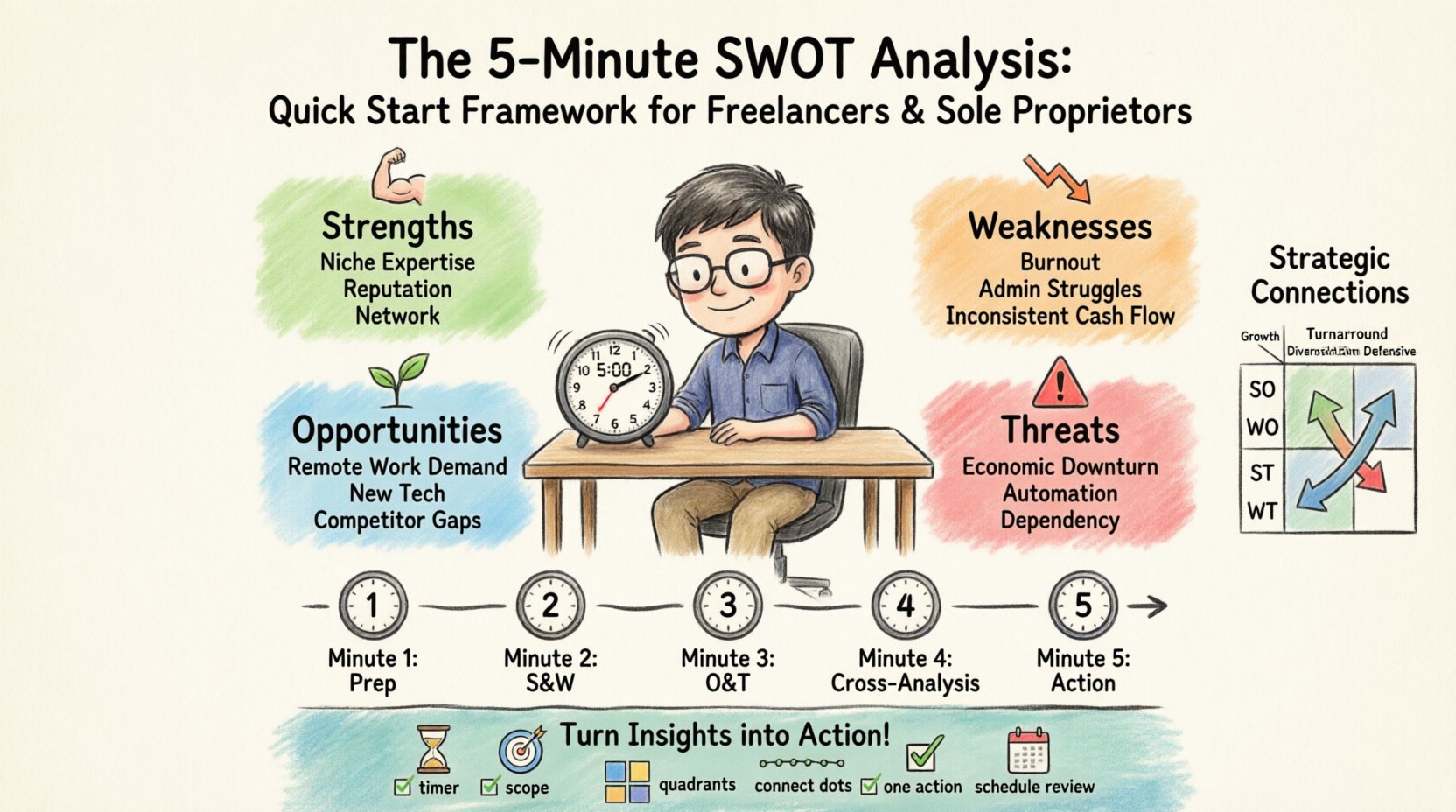
Now that the concepts are clear, here is how to execute the analysis quickly. You do not need a conference room or a whiteboard. You need a blank document or a piece of paper. Set a timer for five minutes. Do not stop until the timer goes off. The pressure forces you to focus on what matters most rather than getting stuck on details.
- Minute 1: Preparation. Clear your workspace. Open your notes app or grab a pen. Define the scope. Are you analyzing your entire business or a specific service line? Keep it focused.
- Minute 2: Strengths & Weaknesses. Quickly list your top three internal positives and top three internal negatives. Do not overthink. Trust your gut.
- Minute 3: Opportunities & Threats. List your top three external positives and top three external negatives. Look at the market environment.
- Minute 4: Cross-Analysis. Look at the lists together. How can a strength help you seize an opportunity? How can a weakness make you vulnerable to a threat?
- Minute 5: Action. Write down one immediate action item based on your findings. This ensures the analysis leads to results.
Detailed Breakdown for Freelancers 🛠️
Let us expand on each quadrant with specific examples relevant to independent workers. This helps you see how to apply the theory to your daily reality.
Strengths: What You Bring to the Table
When listing strengths, avoid generic terms like “hard work.” Be specific. Consider the following categories:
- Technical Expertise: Do you use a software stack that your clients prefer? Are you certified in a high-demand language?
- Reputation: Do you have testimonials? Do people trust your judgment?
- Flexibility: Can you pivot your schedule to meet urgent client needs?
- Niche Knowledge: Do you understand the specific regulations of an industry better than generalists?
- Network: Do you have a list of past clients who might hire you again?
Weaknesses: Where You Are Vulnerable
Weaknesses are often the hardest to admit. However, they are the most important to manage. Consider these common areas:
- Pricing Strategy: Are you undercharging because you fear losing clients?
- Admin Tasks: Do you struggle with invoicing, contracts, or bookkeeping?
- Work-Life Balance: Are you working late hours, risking burnout?
- Marketing Consistency: Do you only market when you need money?
- Specialization: Are you trying to do too many different things and diluting your brand?
Opportunities: Market Shifts to Watch
Opportunities come from the outside world. You must be observant to spot them. Look for these signals:
- Industry Trends: Is there a new regulation requiring services you provide?
- Competitor Gaps: Is a competitor raising prices or dropping quality?
- Platform Changes: Has a social media algorithm changed that favors your content type?
- Partnerships: Are there other freelancers whose services complement yours?
- Geographic Shifts: Are clients in a new region looking for remote workers?
Threats: Risks to Mitigate
Threats require vigilance. You cannot stop them, but you can prepare. Common threats include:
- Economic Downturn: Will clients cut budgets if the economy slows?
- Automation: Can AI tools do parts of your job faster?
- Dependency: Do you rely on one platform for 80% of your income?
- Competition: Are new entrants flooding the market with lower rates?
- Regulatory Changes: Are tax laws or visa rules changing for your region?
Strategic Matrix: Turning Analysis into Action 📊
Having four lists is not enough. You need to connect them. This is where the real strategy happens. You can use a simple table to map your findings. This connects your internal state with external conditions. This method helps you prioritize which problems to solve first.
| Internal Factors | External Factors |
|---|---|
| Strengths | Opportunities |
| How do I use my strengths to take advantage of opportunities? | Example: Use my niche expertise (S) to target new market demand (O). |
| Weaknesses | Opportunities |
| How do I fix weaknesses to take advantage of opportunities? | Example: Hire an assistant (fix W) to handle admin so I can pursue new leads (O). |
| Strengths | Threats |
| How do I use my strengths to avoid threats? | Example: Use my strong reputation (S) to retain clients during a recession (T). |
| Weaknesses | Threats |
| How do I fix weaknesses to avoid threats? | Example: Diversify income sources (fix W) to survive platform algorithm changes (T). |
Using this matrix prevents you from focusing only on one side of the equation. It forces you to see how your internal capabilities interact with the external world. This is where you find the most high-impact actions.
Common Pitfalls to Avoid 🚫
Even with a simple framework, there are ways to mess it up. Since you are doing this quickly, the risk of superficiality is higher. Be aware of these common traps.
1. Being Too Vague
Writing “Good communication” as a strength is not helpful. What does that mean? Does it mean you reply to emails fast? Does it mean you explain technical concepts simply? Specificity allows you to act on the insight. If you write “Fast response time,” you can measure it. If you write “Good communication,” you cannot.
2. Confusing Internal and External
It is common to put “Economy is bad” under Weaknesses. That is a Threat. It is external. You cannot fix the economy. You can only fix your spending habits (Weakness) in response to it. Keep the lines clear. If you can control it, it is internal. If you cannot, it is external.
3. Ignoring the Weaknesses
Freelancers often focus on selling their strengths. They ignore their weaknesses. This is dangerous. A business can be strong in delivery but weak in finance. If the finances fail, the delivery doesn’t matter. You must address the weaknesses that pose a risk to survival.
4. Doing It Once and Forgetting
A SWOT analysis is not a one-time event. The market changes. Your skills change. If you do this analysis once and file it away, it loses value. Treat it as a living document. Revisit it quarterly or whenever you feel stuck.
Turning Insights into a Roadmap 🗺️
Once you have your matrix, you need a plan. Do not try to fix everything at once. Pick the most critical intersection. For example, if you have a Strength that aligns with an Opportunity, that is a growth strategy. If you have a Weakness that aligns with a Threat, that is a risk mitigation strategy.
Here is how to build the next steps:
- SO Strategies (Growth): Identify where you can expand. Maybe you use your existing network to launch a new service. This is low-hanging fruit.
- WO Strategies (Improvement): Identify where you need to invest. Maybe you need to learn a new skill to seize a market trend. This requires effort but offers high reward.
- ST Strategies (Defense): Identify how to protect your business. Maybe you use your reputation to lock in long-term contracts before a market downturn.
- WT Strategies (Survival): Identify where you need to cut losses. Maybe you stop offering a service that is becoming unprofitable due to external competition.
When to Revisit Your Analysis 🔄
Timing is everything. You do not need to do this every day. However, waiting too long means you lose context. Consider these triggers for a new session:
- Quarterly Reviews: Align this with your financial review. It helps connect money with strategy.
- Major Life Changes: Moving cities, getting married, or having a child changes your capacity and needs.
- Client Loss: Losing a major client is a threat. Use the analysis to see if your weakness made you vulnerable.
- New Competitors: If a new agency opens nearby or a new tool launches, reassess the threat level.
- Stagnation: If your income has flatlined for three months, your strategy may be outdated.
Frequently Asked Questions ❓
Is this suitable for startups?
Yes. While this guide focuses on freelancers, the logic applies to any small business. The constraint of time and resources makes the quick version even more valuable for startups.
Do I need to share this with anyone?
No. This is a personal tool. Some people like to share it with a mentor for feedback. Others prefer to keep it private. The value is in the clarity it gives you, not the sharing of it.
What if I find too many threats?
This indicates a high-risk environment. It does not mean you should quit. It means you need to prioritize your Weaknesses. You need to shore up your internal defenses before trying to expand. Focus on stability before growth.
Can I do this with a team?
Absolutely. A team SWOT analysis can be more comprehensive. However, ensure you facilitate it well so one voice does not dominate. For a freelancer, the solo process is faster and more honest.
How detailed should the notes be?
Brief is better. You are aiming for a 5-minute session. If you find yourself writing paragraphs, you are drifting into a full business plan. Keep the notes to bullet points. You can expand on them later if needed.
Final Thoughts on Strategic Clarity 🧭
Building a business alone is a marathon, not a sprint. It requires moments of reflection to ensure you are running in the right direction. This 5-minute SWOT analysis is a tool for that reflection. It cuts through the noise and gives you a clear view of your position. By understanding your internal capabilities and external environment, you make better decisions. You stop reacting and start acting.
Remember that the goal is not to create a perfect document. The goal is to create awareness. Awareness leads to action. Action leads to results. Start with the five minutes. Grab your pen. Define your reality. Then move forward with confidence.
Next Steps Checklist ✅
- Set a timer: Commit to five minutes.
- Define the scope: Business wide or specific project?
- List the four quadrants: S, W, O, T.
- Connect the dots: Use the matrix table.
- Write one action: What will you do tomorrow?
- Schedule the next review: Set a date in your calendar.