
Running a business demands constant vigilance. Markets shift, competitors adapt, and internal dynamics evolve. For a founder or executive, the traditional SWOT analysis often feels like a time-consuming exercise that gathers dust. It is too vague, too lengthy, and rarely yields immediate action.
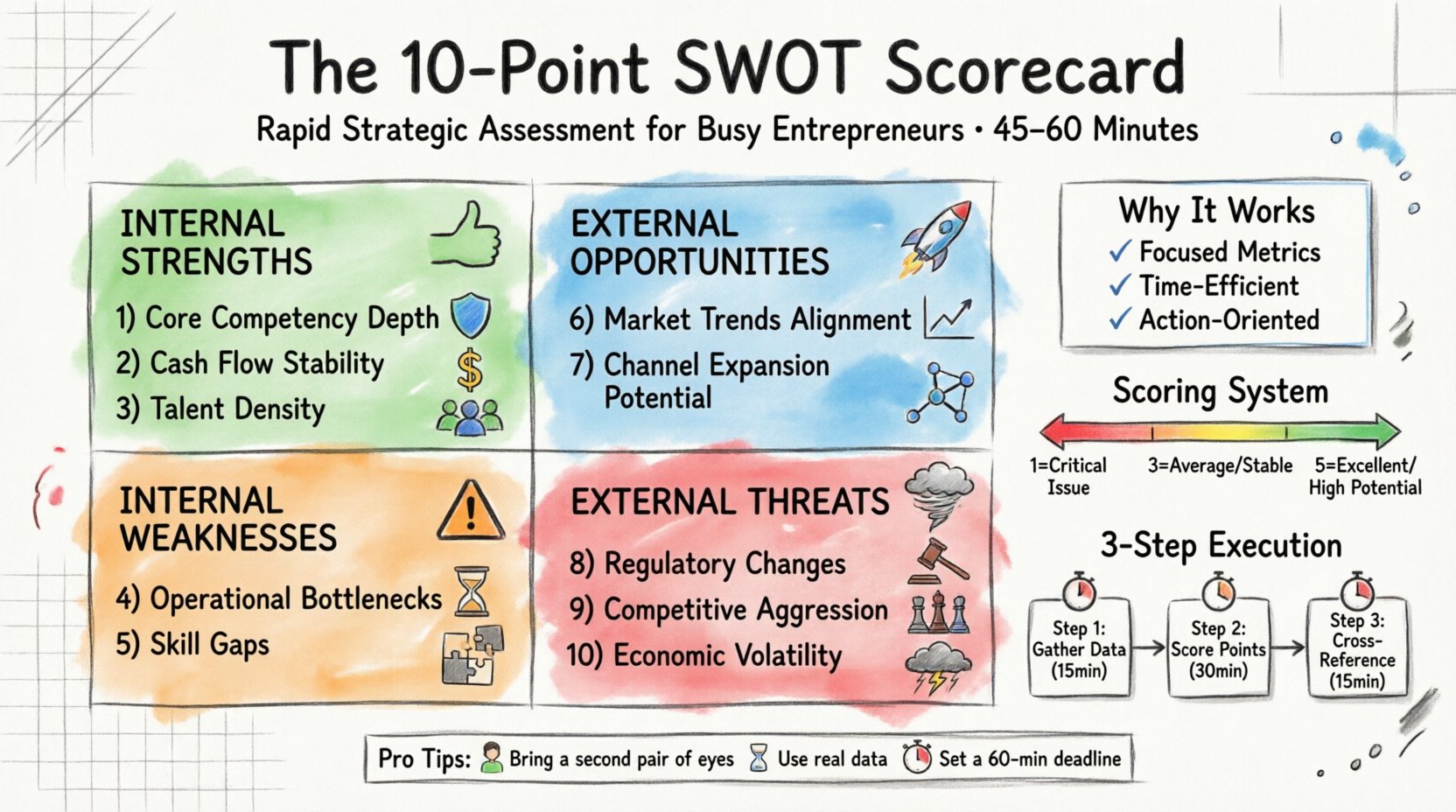
This guide introduces the 10-Point SWOT Scorecard. It is a structured framework designed for speed and precision. It distills the classic Strengths, Weaknesses, Opportunities, and Threats model into ten specific, actionable criteria. This approach allows you to conduct a full strategic audit in a single session without losing depth.
Why Standard SWOT Analysis Fails Busy Founders ⏳
Most business owners attempt SWOT analysis using broad categories. They list “Good Reputation” as a strength or “High Costs” as a weakness. While accurate, these statements lack specificity. They do not guide decision-making.
The 10-Point Scorecard addresses three common failure points:
- Lack of Focus: It forces you to look at specific metrics rather than general feelings.
- Time Efficiency: It can be completed in 45 to 60 minutes.
- Actionability: Each point requires a binary or scored response, eliminating ambiguity.
When you move from vague statements to data-driven points, you transition from thinking to planning.
The Framework: Understanding the 10 Points 🔢
The scorecard divides the traditional four quadrants into ten distinct areas. This distribution ensures you do not overlook critical operational or market factors. The structure is balanced, with three points for internal factors and seven points for external interactions.
Below is the breakdown of the 10 points. Each point includes a definition and specific questions to ask during your assessment.
Part 1: Internal Strengths (Points 1-3) 💪
Strengths are internal capabilities that give you an advantage. In this scorecard, we narrow this down to three critical areas.
Point 1: Core Competency Depth
Definition: How unique and difficult to replicate is your primary value proposition?
- Question: Can a competitor copy your main service within 30 days?
- Example: Proprietary algorithms, exclusive supplier contracts, or specialized team expertise.
Point 2: Cash Flow Stability
Definition: The ability to sustain operations without external funding for a set period.
- Question: How many months of operating expenses are covered by current reserves?
- Example: Positive cash flow for six consecutive months.
Point 3: Talent Density
Definition: The ratio of high-performing employees to total headcount.
- Question: Do you have a team capable of executing strategy without constant supervision?
- Example: Key roles filled by industry veterans with proven track records.
Part 2: Internal Weaknesses (Points 4-5) ⚠️
Weaknesses are internal limitations that hinder performance. Identifying these requires honesty.
Point 4: Operational Bottlenecks
Definition: Processes that slow down delivery or increase costs.
- Question: Where does work pile up before being resolved?
- Example: Manual data entry, approval chains taking more than 48 hours, or legacy software integration issues.
Point 5: Skill Gaps
Definition: Missing capabilities within the current team structure.
- Question: What strategic task cannot be performed by current staff?
- Example: Lack of internal marketing expertise or no dedicated data analyst.
Part 3: External Opportunities (Points 6-7) 🚀
Opportunities are external conditions you can leverage for growth.
Point 6: Market Trends Alignment
Definition: How well your product fits current consumer behavior shifts.
- Question: Is demand for your category growing or shrinking?
- Example: Shift towards remote work tools or increased demand for sustainable packaging.
Point 7: Channel Expansion Potential
Definition: Untapped distribution methods available to you.
- Question: Are there new platforms or partners you have not yet tested?
- Example: Licensing technology to larger firms or entering a new geographic region.
Part 4: External Threats (Points 8-10) 🌪️
Threats are external factors that could cause harm or loss.
Point 8: Regulatory Changes
Definition: New laws or compliance requirements impacting operations.
- Question: Are there pending legislation changes in your industry?
- Example: Data privacy laws or tax structure adjustments.
Point 9: Competitive Aggression
Definition: The intensity of rival activities in your market space.
- Question: Have competitors recently lowered prices or increased marketing spend?
- Example: A major player launching a direct substitute product.
Point 10: Economic Volatility
Definition: Macro-economic factors affecting purchasing power.
- Question: How sensitive is your customer base to price increases?
- Example: High inflation rates reducing discretionary spending budgets.
Executing the Scorecard: A Step-by-Step Guide 🛠️
Having the framework is only half the battle. The execution must be disciplined to yield value. Follow this process to ensure accuracy.
Step 1: Gather Data (15 Minutes) 📝
Do not rely on memory. Collect relevant documents before starting.
- Review the last three months of financial statements.
- Check customer feedback logs and support tickets.
- Scan industry news for recent regulatory or market shifts.
Step 2: Score Each Point (30 Minutes) 📊
Assign a score from 1 to 5 for each point. This quantifies your assessment.
- 1: Critical Issue / Non-Existent Strength
- 3: Average / Stable
- 5: Excellent / High Potential
For internal points (1-5), a low score indicates a weakness. For external points (6-10), a high score indicates a strong opportunity or threat.
Step 3: Cross-Reference Findings (15 Minutes) 🔍
Look for connections between your scores. A strength in one area might mitigate a weakness in another.
- Does high Talent Density (Point 3) offset Skill Gaps (Point 5)?
- Does Cash Flow Stability (Point 2) allow you to weather Economic Volatility (Point 10)?
Scoring Matrix for Quick Reference 📋
Use this table to track your scores during the session.
| Point | Category | Score (1-5) | Notes |
|---|---|---|---|
| 1 | Core Competency Depth | ||
| 2 | Cash Flow Stability | ||
| 3 | Talent Density | ||
| 4 | Operational Bottlenecks | ||
| 5 | Skill Gaps | ||
| 6 | Market Trends Alignment | ||
| 7 | Channel Expansion Potential | ||
| 8 | Regulatory Changes | ||
| 9 | Competitive Aggression | ||
| 10 | Economic Volatility |
Common Pitfalls to Avoid 🚫
Even with a structured scorecard, errors can occur. Be aware of these common traps.
- Confusing Symptoms with Causes: Low revenue is a symptom. The cause might be a weak value proposition or poor distribution. Focus on the root cause in Points 1 and 7.
- Ignoring External Data: Do not assess threats based only on internal feelings. Market trends (Point 6) require external research.
- Over-Optimism: It is easy to rate your Strengths as 5 and Threats as 1. Be objective. If you cannot prove a strength, rate it lower.
- Skipping the Action Plan: A scorecard is useless if no changes follow. Every point below a score of 3 requires an action item.
Integrating the Scorecard into Your Routine 🔄
Strategy is not a one-time event. To keep your business healthy, integrate this assessment into your management rhythm.
Monthly Check-In
For operational leaders, a quick review of Points 1, 2, and 4 is essential. This keeps cash flow and operations in check.
Quarterly Deep Dive
Use the full 10-point scorecard every three months. This allows time for market trends and competitive landscapes to shift significantly.
Annual Strategic Planning
Use the annual scorecard to set long-term goals. If Point 10 (Economic Volatility) scores low, you might decide to build more reserves or diversify revenue streams.
Case Study: Applying the Scorecard to a Service Business 🏢
To illustrate the utility of this framework, consider a mid-sized consulting firm.
Initial Assessment
- Point 1 (Competency): Score 5. Their methodology is unique.
- Point 4 (Bottlenecks): Score 2. Client onboarding takes too long.
- Point 9 (Competition): Score 4. Large firms are entering the niche.
Analysis
The firm has a strong product but a weak delivery process. The threat of large competitors is moderate because their speed is a barrier.
Action Plan
- Fix Point 4: Automate the onboarding workflow.
- Protect Point 1: Document the methodology to prevent knowledge loss.
- Monitor Point 9: Track pricing changes from competitors monthly.
This example shows how the 10 points isolate specific areas for improvement without getting lost in general strategy.
Refining Your Strategy Based on Scores 🔧
Once you have your scores, you need to decide where to invest resources. Here is a guide on resource allocation based on your results.
When Internal Scores are Low (Points 1-5)
Invest in training, hiring, or process improvement. Do not attempt to grow externally if your foundation is weak. Fix the engine before driving faster.
When External Scores are Low (Points 6-10)
Invest in market research and risk mitigation. If threats are high (Points 8-10), focus on compliance and cash reserves. If opportunities are low (Points 6-7), explore new markets or partnerships.
When Scores are Mixed
This is the most common scenario. Prioritize fixing Weaknesses that threaten Strengths. For example, if you have a unique product (Point 1) but poor cash flow (Point 2), focus on monetization immediately.
The Value of Objectivity in Assessment 🧠
The hardest part of this scorecard is removing emotion. Founders often love their products and overlook weaknesses. They fear threats that do not exist.
To maintain objectivity:
- Bring a Second Pair of Eyes: Ask a co-founder or advisor to review your scores. Discrepancies in scoring highlight blind spots.
- Use Data: Where possible, replace opinions with numbers. Use churn rates, burn rates, and conversion rates.
- Set a Deadline: Force a decision within the 60-minute window. Over-thinking leads to analysis paralysis.
Next Steps After the Scorecard 📈
Completing the assessment is the start, not the finish. The value comes from the execution phase.
- Share the Results: Communicate the findings to your team. Transparency builds alignment.
- Create a Tracker: Put the 10 points on a dashboard visible to leadership.
- Schedule Reviews: Put the next scorecard session on the calendar immediately.
By using this 10-Point SWOT Scorecard, you transform strategic planning from a chore into a routine diagnostic tool. It provides clarity in a complex environment and ensures that every decision is backed by a clear understanding of your current position.
Start with the next quarterly review. Gather your data, grab a pen, and score your business against these ten points. The insights you gain will be the foundation for your next period of growth.